Mindfulness
Mindfulness as a Performance Advantage
Welcome back to another edition of Next-Level Skills. Each edition, we explore the human and leadership capabilities that help us navigate work and life more effectively. Skills that move beyond theory and into practical application.
A warm welcome to everyone who has joined our community since the last edition. Whether you've been with us since the beginning or have recently discovered the newsletter or the book, thank you for being part of this journey.
This week, we slow things down to speed things up. We’re diving into mindfulness, not as a wellness buzzword but as a performance strategy. In an age of noise, multitasking, and mental fatigue, mindfulness is not just about calm.
The Coffee That Never Got Cold
It was supposed to be a quick one-on-one. A 15-minute catch-up at a café with a colleague I barely knew outside project updates. I had a list of agenda items in my head - deliverables, blockers, next steps!
But something shifted as we sat down. She looked tired. I noticed her stirring her coffee but not drinking it. So I asked, “How are you, really?”
What followed wasn’t a work update, it was a moment of honesty. She shared that she’d been juggling deadlines with personal challenges at home. She didn’t need solutions. She just needed to be heard. We talked for nearly an hour. No interruptions. No rush.
By the end, she smiled and said, “Thanks for actually being here.”
That coffee never went cold. Because for once, we weren’t managing tasks. We were practising presence.
Why Mindfulness is a Professional Superpower
Mindfulness means training our attention to focus intentionally on the present without judgement. It’s not about tuning out. It’s about tuning in.
Research shows mindfulness improves cognitive performance, reduces stress, and increases emotional intelligence. In work settings, it enhances our listening, decision-making, and even creativity.
Between stimulus and response there is a space. In that space is our power to choose our response.
— Viktor Frankl
Mindfulness helps us widen that space.
Let’s look at how to activate it in a practical way.
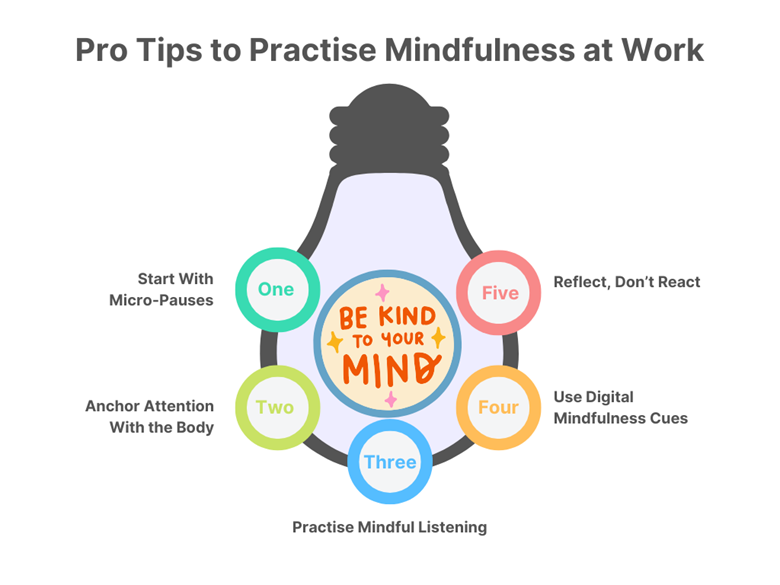
1. Start With Micro-Pauses
These pauses are where awareness grows. It’s not about meditation, it’s about presence.
2. Anchor Attention With the Body
This grounds us when stress spikes. It shifts us from autopilot to awareness.
3. Practise Mindful Listening
Mindful listening builds trust and dissolves reactivity. It creates the space for meaningful dialogue.
4. Use Digital Mindfulness Cues
Mindfulness is a habit of interruption. These cues can reboot our attention multiple times a day.
5. Reflect, Don’t React
Reflection changes the outcome. It helps us lead with intention, not impulse.
This and other essential skills are covered in Next-Level Skills — the book.
Learn more about the Book →A Challenge
Try these three simple mindfulness actions this week:
Reflection Questions
Some Final Thoughts...
Mindfulness is not about becoming slower. It’s about becoming sharper. When we train our mind to stay in the present, we make better decisions, build stronger relationships, and experience more fulfilment in our work.
You can’t stop the waves, but you can learn to surf.
— Jon Kabat-Zinn
Let’s train our attention like we train any other skill. Because in a world that rewards urgency, presence is a quiet form of power.
Until Next Time,
Abhishek
Founder & CEO, LegiQ | Building Intelligent Edge Hardware
How can we build more mindfulness into our team culture, not just our personal habits?
Do we notice when we’re distracted, or only after it costs us something?
What’s one daily routine where we could add a micro-pause?
Have we ever made a poor decision simply because we rushed?
When was the last time we were fully immersed in our work?
What does it feel like when someone gives us their full attention?
What’s one distraction we could remove for just one hour today?
How often do we reflect versus react in moments of stress?
What’s one situation this week where mindfulness helped us respond more wisely?
How would our leadership shift if we were just 10 percent more present?
Gift the Book
- ✓A colleague stepping into leadership.
- ✓A team member navigating change.
- ✓A friend looking to take their next step professionally.
This and other essential skills are covered in Next-Level Skills — the book.
Learn more about the Book →This edition is reserved for supporters
Subscribe free, then unlock every past edition with just 1 successful referral.
Subscribe Free →Enjoyed this edition?
Get the next one in your inbox — first week of every month.