Attention to Details
Precision Thinking : The Power of Paying Attention
Welcome back to another edition of Next-Level Skills. Each edition, we explore the human and leadership capabilities that help us navigate work and life more effectively. Skills that move beyond theory and into practical application.
A warm welcome to everyone who has joined our community since the last edition. Whether you've been with us since the beginning or have recently discovered the newsletter or the book, thank you for being part of this journey.
This week, we zoom in on a deceptively simple yet deeply strategic skill: Attention to Detail.
In a world where speed often trumps precision, this underrated ability quietly separates excellence from average.
The Slide That Almost Undermined the Strategy
It was a high-stakes board presentation. Months of data, strategy, and visuals prepared to influence millions in funding. Yet just before walking into the room, someone spotted it: a duplicated chart and a typo in the headline slide - right next to the company name.
It was corrected in time, but the moment stayed with me. We had done the thinking but had missed the final check.
It wasn’t a lack of intelligence - it was a lack of intentional attention. That small miss could have cost us credibility.
Since then, we've built in habits and systems that
Why Attention to Detail Matters in Every Role
Whether we are writing emails, managing projects, analysing data, or leading teams - attention to detail signals care, discipline, and professionalism. It builds trust. It prevents errors. And it shows respect for both our own work and those we serve.
It’s the little details that are vital. Little things make big things happen.
— John Wooden
In a world of automation and scale, detail is still distinctly human and distinctly powerful.
Let’s explore how we can develop this skill more consciously and systematically.
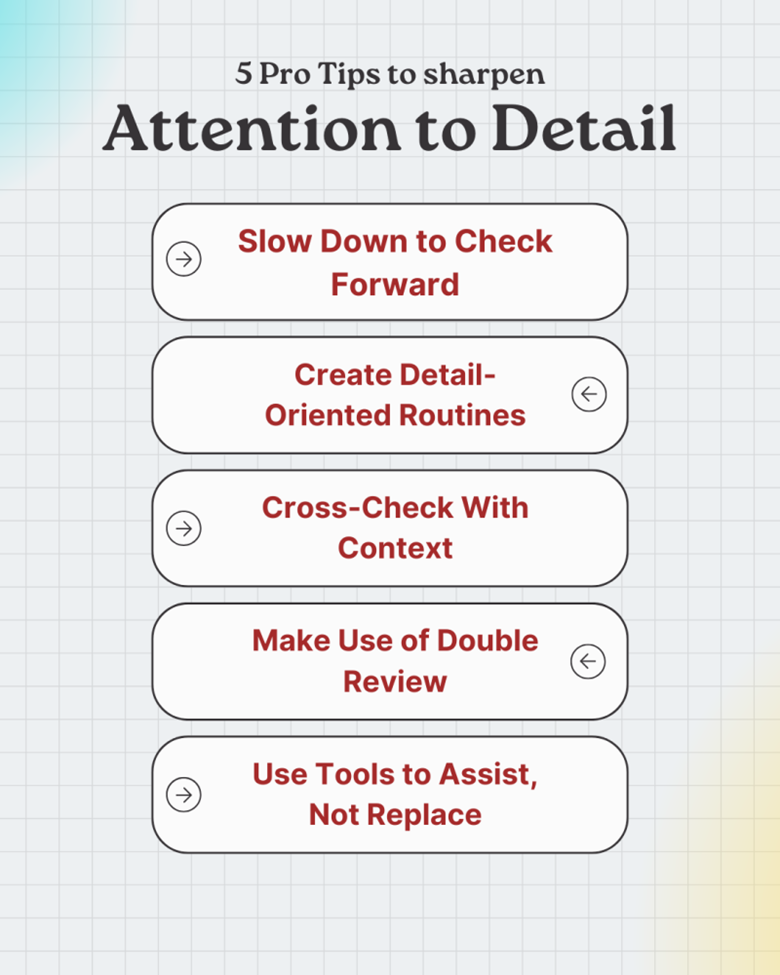
1. Slow Down to Check Forward
Pro Tip: When finishing any task, allocate time not just to complete but to check.
Step away, return with fresh eyes, and review with a checklist. Accuracy improves dramatically when we add time for review into our workflow - not as an afterthought, but as a design.
2. Create Detail-Oriented Routines
Pro Tip: Build standard checklists or templates for repeat tasks.
Whether it’s emails, reports, or client decks, use structure to capture small but critical elements. Routines reduce errors and save mental energy for the more complex parts of the job.
3. Cross-Check With Context
Pro Tip: Look at details not in isolation, but in relation to the whole.
Does this number contradict a previous figure? Does this sentence align with the objective? Contextual checking helps surface inconsistencies that a narrow focus might miss.
4. Make Use of Double Review
Pro Tip: For high-impact work, invite a second set of eyes - especially someone outside the process.
A peer review often catches what we overlook. Fresh perspectives spot patterns and blind spots we’re too close to see.
5. Use Tools to Assist, Not Replace
Pro Tip: Leverage spelling, grammar, and version control tools, but never rely on them fully.
Human insight is still needed for tone, alignment, and accuracy. Tech is a partner, not a substitute. Combine digital support with human judgment.
This and other essential skills are covered in Next-Level Skills — the book.
Learn more about the Book →A Challenge
Here are three small practices you could try this week to sharpen attention to detail:
Reflection Questions
Some Final Thoughts...
Attention to detail is not about perfectionism. It’s about presence. It’s about the discipline of care, the awareness to slow down, and the habit of finishing well.
Well done is better than well said.
— Benjamin Franklin
Let’s make the small things count - because they always do.
Until Next Time,
Abhishek
Founder & CEO, LegiQ | Building Intelligent Edge Hardware
Are we reinforcing attention to detail in our teams, or just assuming it’s there?
Are we currently mistaking speed for efficiency in our work?
What does our work say about the level of care we bring to it?
How often do we reflect on the final 5 percent of our work - the finishing touches?
Could we build a checklist for our recurring high-stakes tasks?
What small mistake has had a big impact on our credibility or outcomes in the past?
How do we balance attention to detail with the need for speed?
When was the last time a small detail saved us from a large problem?
What signals do we look for that tell us we’re missing something important?
Do we have review systems in place — or are we relying on memory?
Gift the Book
- ✓A colleague stepping into leadership.
- ✓A team member navigating change.
- ✓A friend looking to take their next step professionally.
This and other essential skills are covered in Next-Level Skills — the book.
Learn more about the Book →This edition is reserved for supporters
Subscribe free, then unlock every past edition with just 1 successful referral.
Subscribe Free →Enjoyed this edition?
Get the next one in your inbox — first week of every month.