Integrative Thinking
Integrative Thinking: Seeing Connections Others Miss
Welcome back to another edition of Next-Level Skills. Each edition, we explore the human and leadership capabilities that help us navigate work and life more effectively. Skills that move beyond theory and into practical application.
A warm welcome to everyone who has joined our community since the last edition. Whether you've been with us since the beginning or have recently discovered the newsletter or the book, thank you for being part of this journey.
Before we dive in, a huge thank you to everyone who supported the launch of Next-Level Skills. Hearing how the book is already helping readers think sharper, lead smarter, and navigate work with more clarity has been incredibly humbling.
Have a read if you haven't yet
Today’s topic is a perfect extension of the book, especially Chapter 13 on Integration, where we explore how multiple skills come together to elevate our impact.
Let’s explore one of the most powerful leadership capabilities of all: Integrative Thinking.
A Lesson from Two Unlikely Leaders
Years ago, I worked with two senior leaders who had very different styles. One excelled at details and execution. The other had a talent for long-term vision but struggled with the day-to-day.
Individually, both were good. Together, they were extraordinary.
During a complex transformation initiative, they discovered something surprising. The best solutions weren’t in choosing one perspective over another but in weaving both into a new approach that neither had considered on their own. The project became one of the most successful in the organisation, not because of compromise, but because of combination.
That is the essence of integrative thinking. It sits at the intersection of multiple viewpoints, transforming tension into innovation.
What Integrative Thinking Really Means
Integrative thinking is the ability to hold opposing ideas, examine the strengths in each, and create a better solution that sits beyond either option.
Roger Martin, one of the leading thinkers on the topic, describes it as the habit of refusing to accept trade-offs as the only path forward.
In practical terms, it means:
- →seeing patterns in complexity
- →connecting ideas that seem unrelated
- →designing solutions that satisfy multiple needs at once
- →stepping above binary thinking and into possibility thinking
In a world filled with competing priorities and rapid change, this capability has become a strategic advantage. And for many professionals, it is the missing link between good decision-making and great leadership.
We cannot integrate well without first developing the foundational skills.
This is why the book’s design reinforces integrative thinking as the final step: the ability to link self-management, interpersonal mastery, strategic clarity, and sustained purpose.
Why It Matters More Than Ever
We operate in environments where problems are rarely simple. Challenges are multi-layered, stakeholders are diverse, and solutions are rarely linear.
They design a way to achieve both. They do not settle for the safest idea or the boldest idea. They create the most purposeful idea.
This mindset allows us to:
- →lead confidently when the path is unclear
- →make decisions without getting stuck in either-or choices
- →resolve conflicts with more depth and empathy
- →innovate without discarding what already works
- →When we master integrative thinking, we stop reacting and start shaping.
The Building Blocks of Integrative Thinking
To integrate ideas well, we draw on a blend of emotional, interpersonal, and strategic skills. That is why it fits beautifully into the final chapter of Next-Level Skills.
Here are the key foundations that support this capability:
- 1Self-AwarenessWe need to understand our biases and default thinking patterns, so we can step beyond them.
- 2Empathy and ListeningIntegrating perspectives requires understanding perspectives. Active listening gives us the insight needed to combine ideas, not dismiss them.
- 3Strategic ThinkingSeeing the forest and the trees helps us map how decisions connect.
- 4AdaptabilityIntegration is not about holding tightly to one idea. It is about shaping ideas until they fit the context.
Each of these skills appears throughout the book for a reason. They are not standalone. They build toward a mindset where integration becomes second nature.
Five Pro Tips for Developing Integrative Thinking

- 1Pro Tip: Replace Either with 'And'Whenever faced with two options, pause and ask. What would a solution look like that honours both? This simple mental shift opens the door to more creative possibilities.
- 2Pro Tip: Map the Tension PointsWrite down the strengths and risks of each option. This helps us see what is valuable in both perspectives rather than choosing sides.
- 3Pro Tip: Borrow from Other DomainsGreat integrators look beyond their own field. Strategy ideas from sport, design, psychology, or aviation often spark breakthroughs.
- 4Pro Tip: Slow the Thinking, Speed the InsightIntegration requires reflection time. Build micro-pauses into decision-making to connect ideas that would otherwise slip past.
- 5Pro Tip: Invite Opposing ViewsAsk people who think differently from us to challenge our thinking. Diverse input is the raw material of integrative solutions.
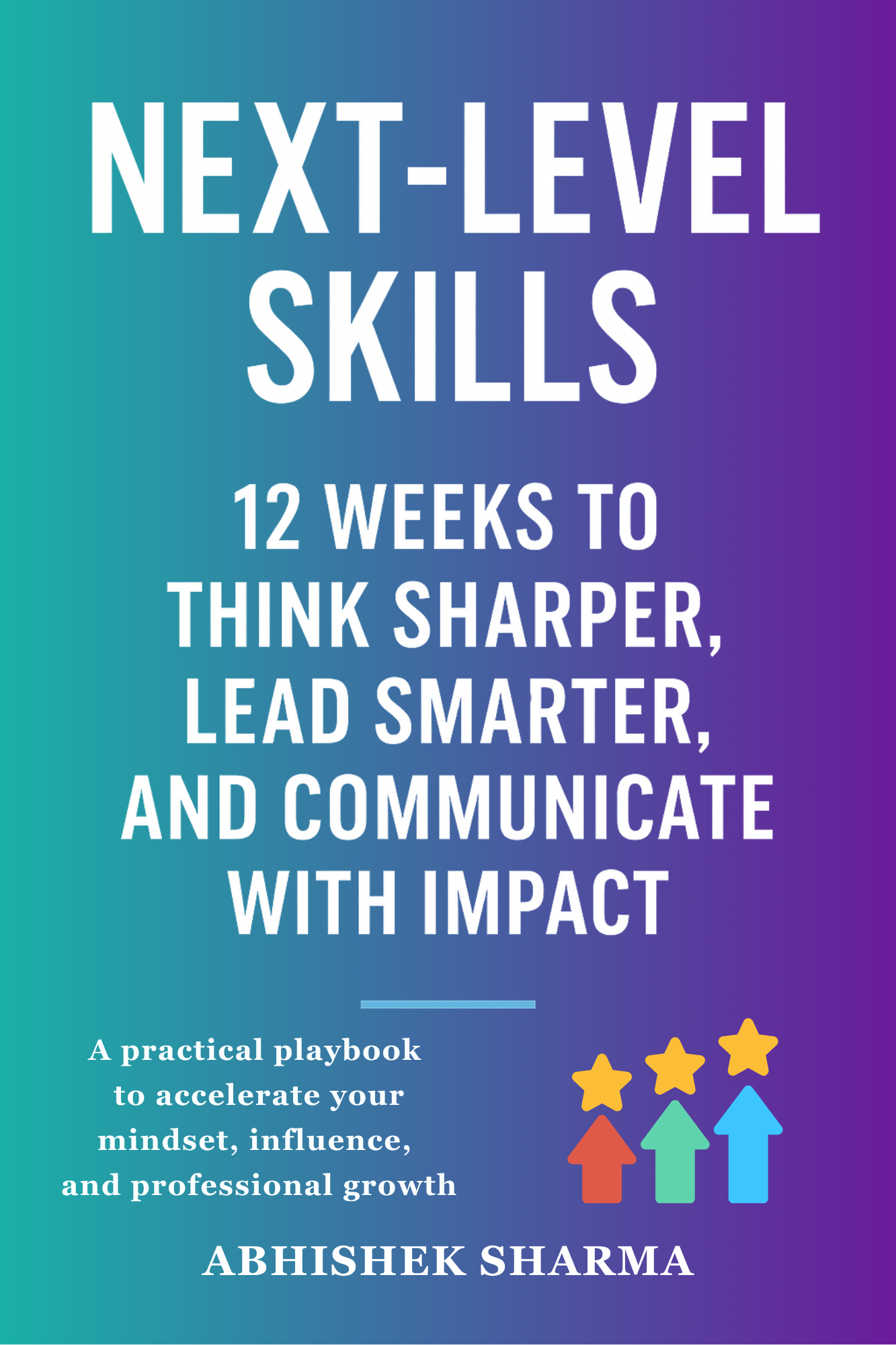
This and other essential skills are covered in Next-Level Skills — the book.
Learn more about the Book →A Reflection for This Week
Try this simple exercise. The next time you face a tough decision, resist the urge to choose quickly. List the two or three strongest opposing ideas.
Reflection Questions
Some Final Thoughts...
Integrative thinking is not just a skill. It is a leadership philosophy.
It invites us to see more, think deeper, and design solutions that elevate everyone involved.
Because true growth is not about mastering individual skills. It is about bringing them together in a way that transforms how we think, work, and lead.
If you have started reading the book, I hope this week’s topic helps you connect even more deeply with the ideas inside it. And if you have not yet picked up your copy, I hope this gives you a taste of how the skills build upon one another to create meaningful, sustained growth.
Onwards to the next chapter of learning.
Until Next Time,
Abhishek
Founder & CEO, LegiQ | Building Intelligent Edge Hardware
How can teams use integrative thinking to reduce conflict and increase innovation?
Which foundational skill do you think contributes most to integrative thinking?
What areas of your work would benefit most from a more integrative approach?
When was the last time you created a solution that combined multiple viewpoints instead of choosing one?
Do you naturally lean toward detail focus or big-picture thinking?
How often do you invite opposing perspectives before making decisions?
How could integrative thinking support your long term personal development?
What is one tension you could map out this week to find a better solution?
What is an example of a great integrative thinker you admire and why?
Has reading the book shifted the way you connect ideas in your role?
Gift the Book
- ✓A colleague stepping into leadership.
- ✓A team member navigating change.
- ✓A friend looking to take their next step professionally.
This and other essential skills are covered in Next-Level Skills — the book.
Learn more about the Book →This edition is reserved for supporters
Subscribe free, then unlock every past edition with just 1 successful referral.
Subscribe Free →Enjoyed this edition?
Get the next one in your inbox — first week of every month.