From Skills to Identity
Why Integration Beats Accumulation Every Time!
Welcome back to another edition of Next-Level Skills. Each edition, we explore the human and leadership capabilities that help us navigate work and life more effectively. Skills that move beyond theory and into practical application.
A warm welcome to everyone who has joined our community since the last edition. Whether you've been with us since the beginning or have recently discovered the newsletter or the book, thank you for being part of this journey.
This newsletter began as a weekly practice in building one skill at a time. Over the past year, we explored more than fifty skills together, from listening and resilience to influence and strategic thinking. Thank you to every reader who has stayed curious, reflective, and committed along the way. Your consistency is what made this journey meaningful.
Now, as this newsletter moves into a monthly rhythm and the book Next-Level Skills is out in the world, it feels like the right moment to pause, step back, and look at the bigger picture of growth.
Because learning more is not the same as becoming more.
And that brings us to this month’s theme.
When Growth Slows, Even Though We Are Learning More!
There comes a point in every growth journey where something feels off.
We read more. We attend workshops. We collect frameworks, tools, and insights.
Yet despite all that effort, progress begins to feel slower.
Our behaviour does not always change. Under pressure, we still react the same way. In critical moments, the skills we know do not always show up.
This is not a motivation problem. It is not a discipline problem.
It is an integration problem.
Growth stalls when skills live in isolation. When they remain things we know rather than ways we think, decide, and act. And this is exactly why moving from accumulation to integration matters more than ever.
A Moment That Changed How I Thought About Growth
A few years ago, I caught myself giving advice I was not fully living.
I could articulate leadership principles clearly. I understood emotional intelligence. I spoke confidently about communication, trust, and influence. Yet in a tense meeting, under time pressure, I reacted defensively instead of listening. I prioritised speed over clarity. I focused on being right rather than being effective.
Later that day, reflecting on the moment, I realised something uncomfortable.
They existed in different mental folders. Leadership sat in one place. Emotional regulation in another. Communication somewhere else. Under pressure, none of them spoke to each other.
That realisation reshaped how I think about growth, and it is what eventually led to the idea of the continuum of growth in my published book, Next-Level Skills.
Because skills do not fail us. Disconnection does.
The Problem with Treating Skills as Checklists
Most development journeys unintentionally turn into checklists. Learn this. Add that. Improve another area. Isn't it?
While this feels productive, it often fragments growth. Skills become situational. We apply one at a time, consciously, when we remember. But real effectiveness shows up when skills work together automatically. What do you think?
True growth is not about switching skills on and off. It is about who we become when we are not consciously trying. Just like driving a car, we get to do so many things at once, but not consciously... well most of the times! You get the picture!
The best way to predict the future is to create it.
— Peter Drucker
Creation, however, requires coherence, not collection. This is where integration changes everything.
Introducing the Continuum of Growth
In the book Next-Level Skills, growth is not presented as a straight line or a ladder. It is described as a continuum. At one end, skills are learned intellectually. In the middle, they are practised deliberately. At the other end, they become embodied.
On this continuum, skills begin to influence each other.
Self-awareness strengthens emotional regulation. Emotional regulation improves communication. Communication builds trust. Trust enables influence. Influence reinforces leadership. Effective Leadership makes you more self-aware.
This is why the book does not treat skills as standalone chapters only. It shows how they connect, reinforce, and evolve together over time. Growth accelerates when skills stop being tools and start becoming traits.
What Integration Looks Like in Real Life
Integration shows up quietly. It looks like pausing before reacting, without effort. It sounds like asking better questions instinctively. It feels like clarity under pressure, not confusion.
We no longer think, “Which skill should I use here?” We simply respond in alignment with who we are becoming.
James Clear captured this shift perfectly when he wrote,
You do not rise to the level of your goals. You fall to the level of your systems.
— James Clear
In my opinion, integrated skills are exactly that. A personal system for thinking and behaving well.
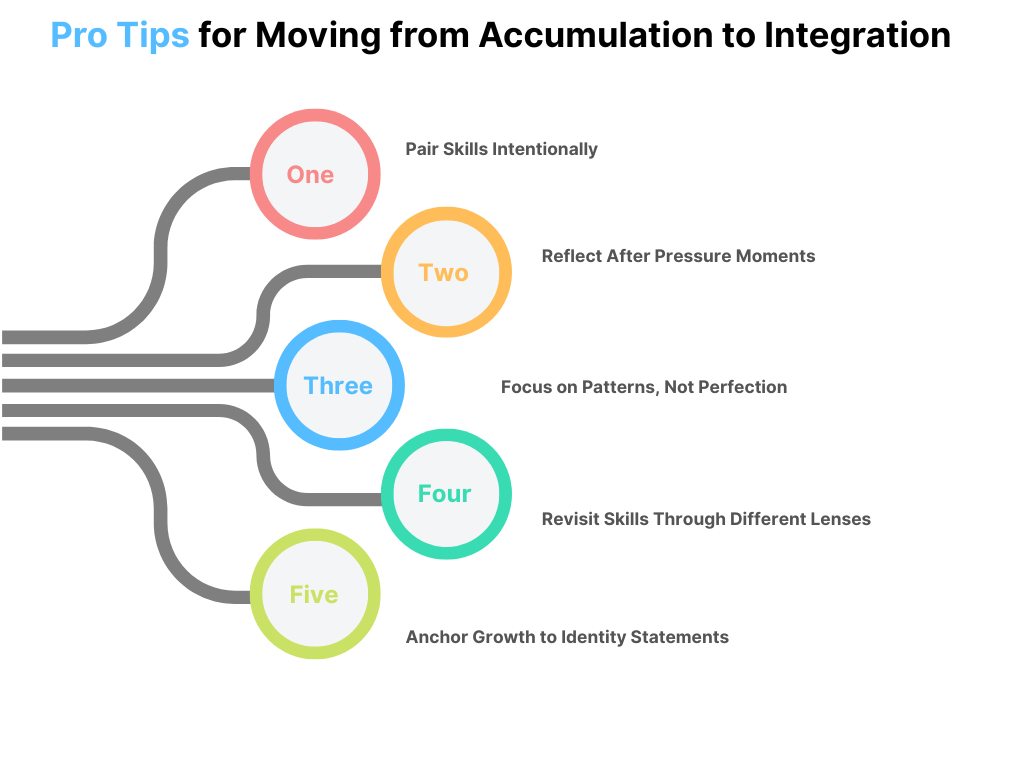
- 1Pro Tip: Pair Skills IntentionallyInstead of practising one skill in isolation, consciously combine two. For example, practise feedback while regulating emotions, or decision-making alongside empathy. Integration begins with deliberate pairing.
- 2Pro Tip: Reflect After Pressure MomentsThe fastest integration happens after stress. Ask what showed up automatically and what did not. These moments reveal which skills are embodied and which are still theoretical.
- 3Pro Tip: Focus on Patterns, Not PerfectionIntegration is not about flawless behaviour. It is about noticing recurring patterns and gently reshaping them over time. Small shifts compound faster than dramatic overhauls.
- 4Pro Tip: Revisit Skills Through Different LensesReturn to the same skill, but through a different context. Leadership looks different under uncertainty than during stability. Revisiting skills deepens integration.
- 5Pro Tip: Anchor Growth to Identity StatementsInstead of saying “I am learning to communicate better,” shift to “I am someone who communicates with clarity.” Identity-based framing accelerates embodiment.
Why This Matters More Now Than Ever
Many of us are not short on knowledge. We are short on coherence. As work becomes faster, more complex, and more emotionally demanding, fragmented skills break down. Integrated skills hold steady. This is why the focus now shifts from learning more to becoming more.
And this is the quiet promise behind Next-Level Skills. Not more information, but a way to bring everything together into a meaningful whole.
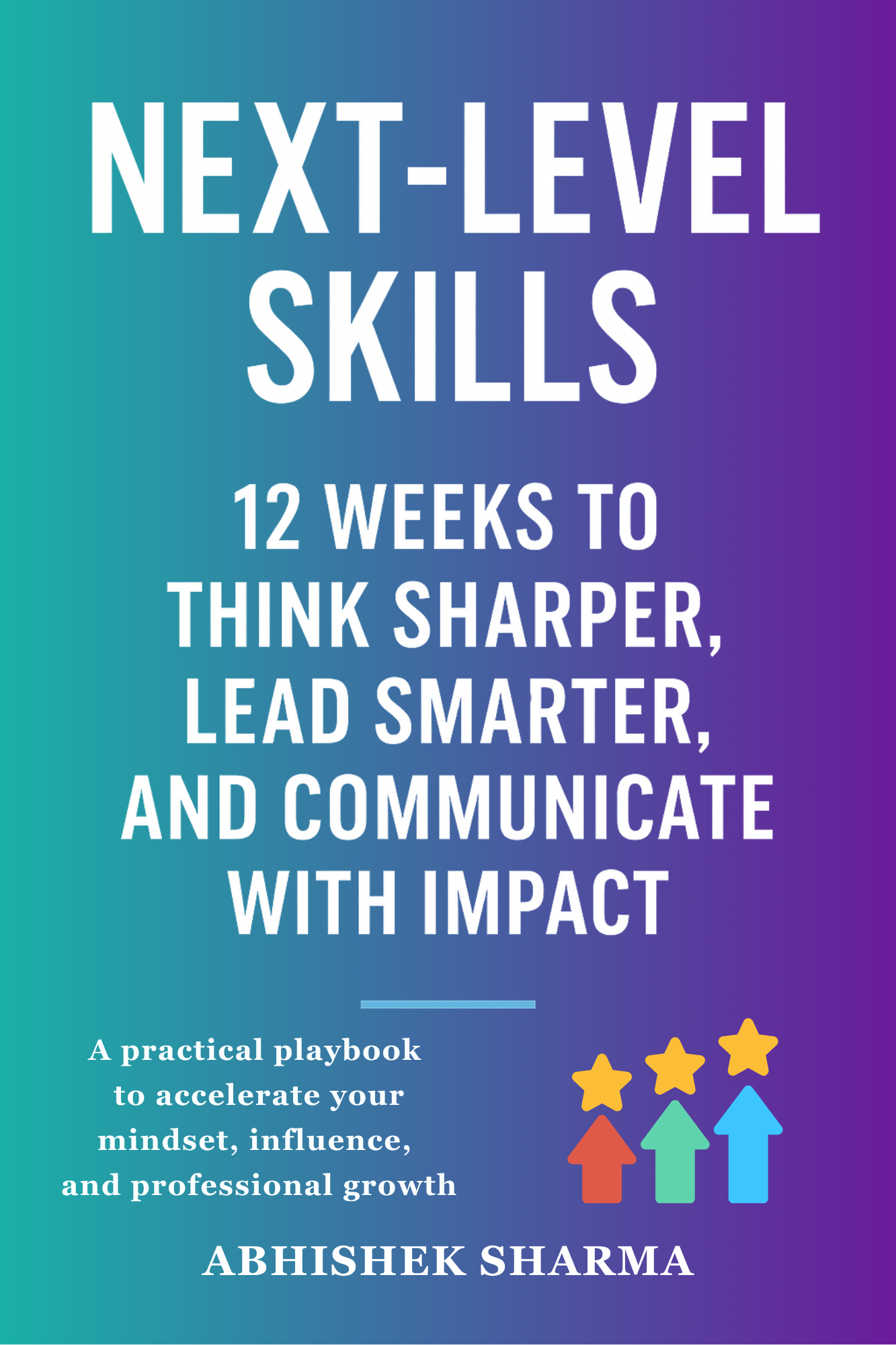
This and other essential skills are covered in Next-Level Skills — the book.
Learn more about the Book →A Challenge for This Month
You do not need to learn a new skill this month.
Instead, choose one existing skill and ask:
Reflection Questions
Some Final Thoughts...
Growth does not happen when we know more. It happens when who we are begins to change. For sure, integration is slower than accumulation, but it is deeper. Quieter, but far more durable.
I am not what happened to me, I am what I choose to become.
— Carl Jung
Integration is the practice of that choice, every day.
Until Next Month,
Abhishek
Founder & CEO, LegiQ | Building Intelligent Edge Hardware
Which skill do you understand well but still struggle to apply under pressure?
Do you think growth slows because we lack knowledge, or because we fail to integrate what we already know?
What is one skill you have learned that has genuinely become part of your identity?
How do you personally move a skill from theory into everyday behaviour?
Which two skills do you think need to work together for real leadership growth?
Have you ever noticed yourself knowing the right thing to do but reacting differently in the moment?
What helps you turn learning into lasting behavioural change?
Do you agree that integrated skills matter more than accumulated knowledge?
Where do you see the biggest gap between what people know and how they actually behave?
What skill disappears most often for you when pressure, urgency, or conflict shows up?
Apply These Skills
- ✓Put the frameworks into practice this month.
- ✓Use the reflection prompts inside the book.
- ✓Build habits that compound over time.
This and other essential skills are covered in Next-Level Skills — the book.
Learn more about the Book →This edition is reserved for supporters
Subscribe free, then unlock every past edition with just 1 successful referral.
Subscribe Free →Enjoyed this edition?
Get the next one in your inbox — first week of every month.