Making Better Decisions Under Pressure
Thinking Clearly When It Matters Most
Welcome back to another edition of Next-Level Skills. Every month, we explore the human and leadership capabilities that help us navigate work and life more effectively. Skills that move beyond theory and into practical application.
A warm welcome to everyone who has joined our community since the last edition. Whether you've been with us since the beginning or have recently discovered the newsletter or the book, thank you for being part of this journey.
This month, we're tackling a challenge every professional faces sooner or later: How do we make good decisions when the pressure is on?
Because the quality of our decisions often determines the quality of our outcomes. And unarguably, pressure has a way of testing both.
The Decision That Couldn’t Wait
Several years ago, I was involved in a project that had reached a critical point. A key dependency had failed. Stakeholders wanted immediate answers. The team was looking for direction. Every minute felt way important than ever. The pressure to decide quickly was intense.
In moments like these, there is a temptation to react. To do something simply because standing still feels uncomfortable.
"Pressure doesn't create character. It reveals our habits.
Instead, we paused. Not for hours. Not for days. But just long enough to separate facts from assumptions.
What became clear was that most of the urgency was real, but much of the panic wasn't.
That small pause changed the quality of the decision and ultimately the outcome. The experience reinforced a lesson that has stayed with me ever since: "Pressure doesn't create character. It reveals our habits."
Why Pressure Changes the Way We Think
Pressure is not inherently bad. In fact, a certain level of pressure can sharpen focus and encourage action (Yerkes-Dodson Law). However, the challenge is that excessive pressure narrows our perspective. We become more reactive. More emotional. More susceptible to bias. And, instead of exploring options, we rush to conclusions. Instead of seeking clarity, we seek relief. And often, relief feels like action.
The problem is that urgent decisions and effective decisions are not always the same thing. This is where great leaders distinguish themselves. They learn how to think clearly even when circumstances are not.
The Myth of the Perfect Decision
Many people believe strong decision-makers always know the right answer. But, the reality is quite the opposite. The best decision-makers rarely have perfect information. What they have is a process.
As Jeff Bezos famously said:
Most decisions should probably be made with somewhere around 70% of the information you wish you had.
— Jeff Bezos
The goal should not be 'certainty'. Instead, we should be looking to make an informed 'progress'.
What High-Quality Decision-Making Looks Like
Under pressure, effective decision-makers tend to do several things consistently. They slow down mentally, even if they must move quickly operationally. They distinguish facts from opinions. They focus on what matters most rather than what is loudest. And they remain willing to adjust course when new information emerges. In other words, they create clarity before creating action.
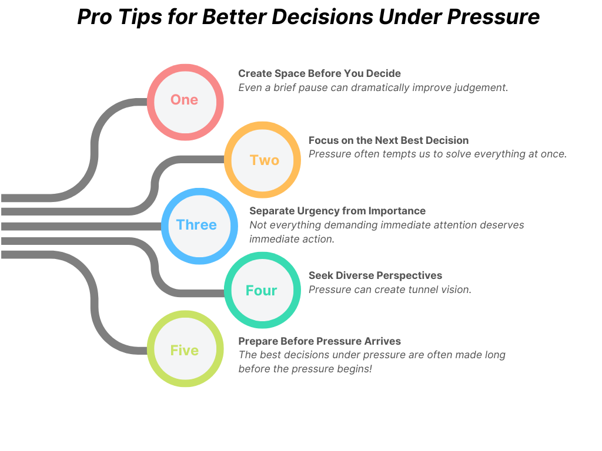
- 1Create Space Before You DecideEven a brief pause can dramatically improve judgement. Before responding, ask yourself what facts you know for certain and what assumptions you might be making.
- 2Focus on the Next Best DecisionPressure often tempts us to solve everything at once. Instead, identify the next decision that moves the situation forward and tackle that first.
- 3Separate Urgency from ImportanceNot everything demanding immediate attention deserves immediate action. Learn to distinguish between what feels urgent and what truly matters.
- 4Seek Diverse PerspectivesPressure can create tunnel vision. Inviting different viewpoints helps reveal blind spots and improves decision quality.
- 5Prepare Before Pressure ArrivesThe best decisions under pressure are often made long before the pressure begins! Build habits, frameworks, and routines that support clear thinking when stakes are high.
Why This Skill Matters More Than Ever
Today's leaders are navigating complexity at a level few previous generations experienced.
- →Information moves faster.
- →Expectations are higher.
- →Change is constant.
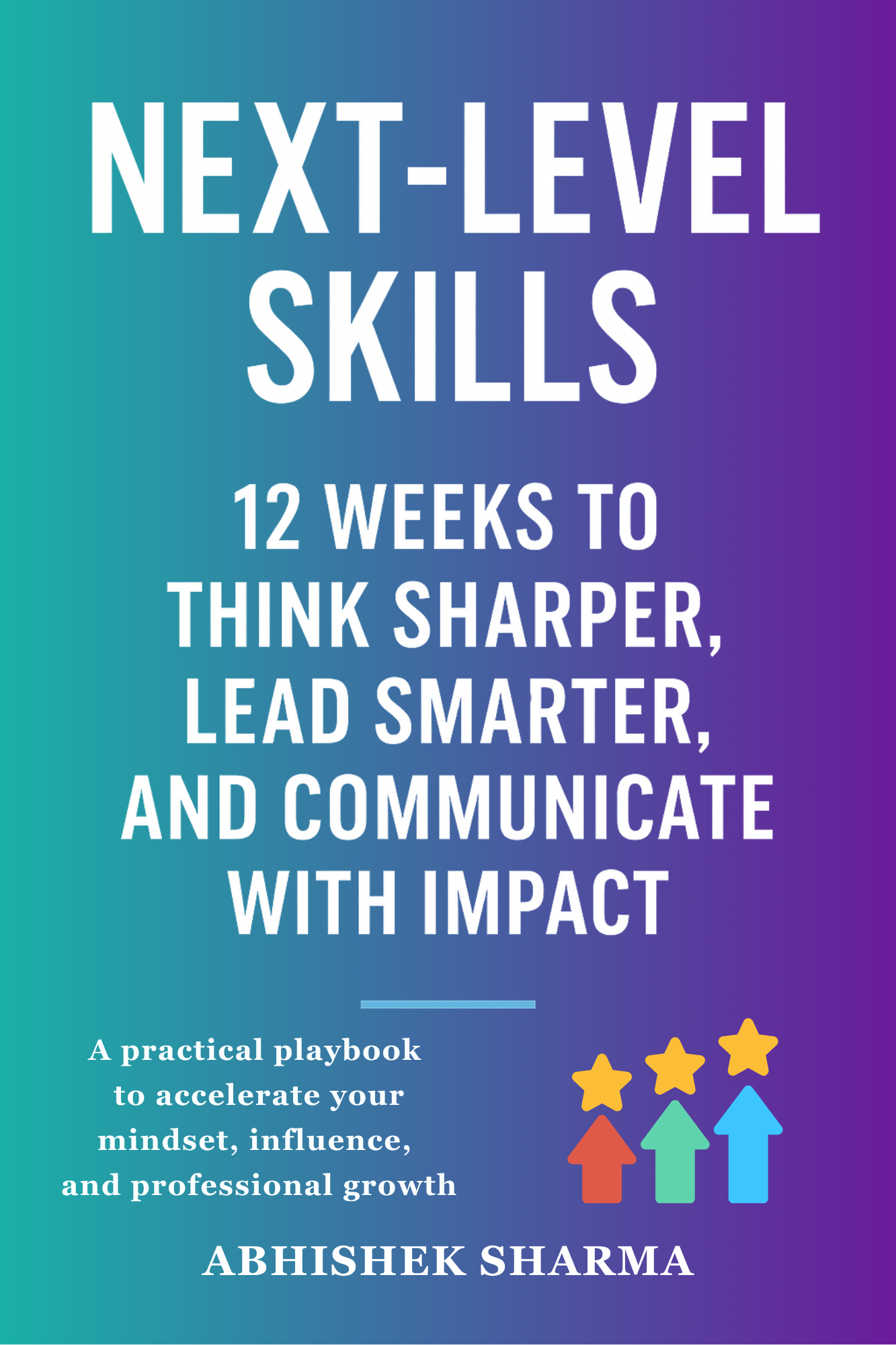
This and 11 other essential skills are covered in Next-Level Skills — the book.
Learn more about the Book →A Reflection for This Month
Reflection Questions
Some Final Thoughts ...
Pressure is inevitable. Poor decisions are not. The leaders who thrive are not those who avoid difficult situations. They are the ones who develop the ability to think clearly within them.
Between stimulus and response there is a space. In that space is our power to choose our response.
— Viktor Frankl
Until next month, keep making better decisions!
Abhishek
Founder & CEO, LegiQ | Building Intelligent Edge Hardware
Additional Food for Thought...
How do you distinguish between urgency and importance when everything feels critical?
What is one decision-making mistake you find yourself repeating?
What is the toughest decision you've had to make under pressure, and what did it teach you?
What frameworks or mental models have improved your decision quality?
What habits help you stay calm when a decision carries significant consequences?
Have you ever made a great decision with limited information? What happened?
How much does emotion influence your decision-making process under pressure?
Who do you turn to for perspective when facing a difficult choice?
Do you tend to make decisions quickly or seek more information first?
If you could improve one aspect of your decision-making, what would it be and why?
Meaningful Discussions within the Community...!
Pressure does not only reveal the decision-maker. It also reveals the decision architecture around them. Under pressure, the real test is whether evidence remains accessible, alternatives remain genuine, and the authority to challenge, pause or escalate is still usable before operational effect. Otherwise, speed can look like clarity while the decision route is already narrowing.
Absolutely. Pressure doesn't just test the individual making the decision, it tests the environment in which the decision is being made. Strong decision-makers matter, but so do strong decision systems. The best leaders create conditions where critical thinking remains possible even when time is limited. They protect space for questions, encourage constructive challenge, and ensure that escalation pathways remain open. In doing so, they improve not only the decision itself, but the architecture that supports future decisions as well. Perhaps one of the most overlooked leadership responsibilities is not making every decision personally, but designing an environment where good decisions can consistently emerge under pressure. Thanks for sharing your thoughts
Appreciate that, Abhishek. I think that is the crucial shift: under pressure, leadership is not only exercised through the decision itself, but through the conditions that still allow the decision to be challenged before commitment. Once that space disappears, speed can become procedural momentum rather than clarity.
Gift the Book, "Next-Level Skills"
- →A colleague stepping into leadership.
- →A team member navigating change.
- →A friend looking to take their next step professionally.
This and 11 other essential skills are covered in Next-Level Skills — the book.
Learn more about the Book →Enjoyed this edition?
Get the next one in your inbox — first week of every month.