Unlearning
What Got You Here Won't Get You There
Welcome back to another edition of Next-Level Skills. Each edition, we explore the human and leadership capabilities that help us navigate work and life more effectively. Skills that move beyond theory and into practical application.
A warm welcome to everyone who has joined our community since the last edition. Whether you've been with us since the beginning or have recently discovered the newsletter or the book, thank you for being part of this journey.
This month, we're exploring a skill that sounds simple, yet is one of the hardest to practice, because it asks us to let go of things that have worked:
Because we spend a lot of time learning new skills, we spend far less time asking which of our old ones have quietly expired.
The Playbook That Stopped Working
A few years ago, I stepped into a bigger role, and I did what had always worked for me.
I jumped in early. I solved problems myself. I was usually the fastest answer in the room, and for years, that speed had been the reason people trusted me.
Almost no one would have questioned an approach with that track record.
But within a few months, something had quietly shifted.
Decisions were slowing down. Good people were waiting to hear what I thought before sharing what they thought. The team wasn't struggling because it lacked capability. It was waiting, because I had trained it to.
It took a colleague's candid comment to make it visible: "You're brilliant in the room, but we've stopped thinking until you've spoken."
That sentence stung. It was also exactly right. The habit that had built my reputation was now the ceiling on my team's growth.
And that is why unlearning deserves far more attention than it usually gets, especially from people who have good reasons to trust what has always worked.
Why Our Strengths Quietly Become Our Blind Spots
Success is a very persuasive teacher.
It rewards what we did, and it quietly convinces us that what we did is what we should keep doing.
The challenge is that the context around us keeps moving, even when our habits don't.
The approach that earned a promotion may not suit the role that follows it.
The style that worked with a small team may strain a larger one.
And as the old habits still continue to produce some results, we rarely notice the point at which they stopped producing the best ones.
Nothing breaks. Nothing announces itself. Progress simply flattens, and we assume the answer is to try harder at what we already know.
The instinct is to treat learning as the way forward. In reality, it is only half of it. The other half is deciding what to put down.
The Myth That More Experience Always Helps
Many people assume that the more experienced we become, the better our instincts get, and that experience is always an advantage.
Experience tells us what worked before.
It cannot tell us whether the conditions that made it work still exist.
And it is that gap, between a confident habit and a changed context, where capable people quietly fall behind.
"The illiterate of the 21st century will not be those who cannot read and write, but those who cannot learn, unlearn, and relearn."
— Alvin Toffler
The goal should not be to discard everything we know. It should be to keep checking whether what we know still fits where we are now.
What Leaders Who Unlearn Do Differently
Across careers and roles, leaders who keep growing past their early success tend to do several things consistently.
- →They separate who they are from how they've always done things.
- →They treat their own habits as hypotheses to test, not facts to defend.
- →They actively look for the feedback that is hardest to hear.
- →And they stay comfortable being a beginner, even when they're the most senior person in the room.
In other words, they make themselves loyal to results, not to routines!
That approach doesn't mean abandoning experience. But it dramatically changes which parts of it we keep carrying forward.
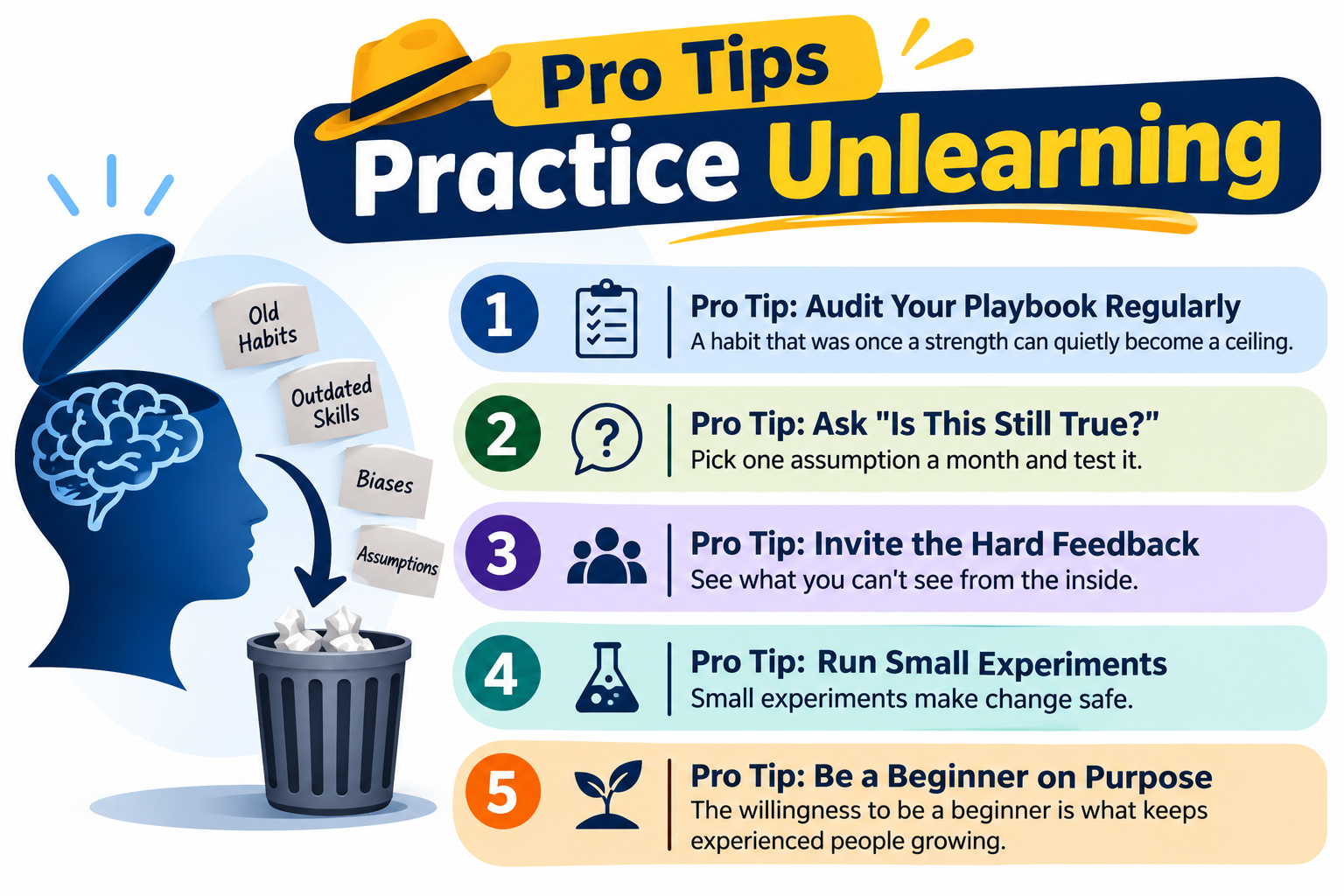
Pro Tip: Audit Your Playbook Regularly
Write down the three or four habits that built your success. Next to each one, ask honestly: "Does this still fit the role, the team, and the moment I'm in now?"
A habit that was once a strength can quietly become a ceiling. The audit isn't about throwing things out, it's about choosing consciously what to keep.
Pro Tip: Ask "Is This Still True?"
Every one of us carries assumptions that were true when we formed them: "clients prefer this," "this team needs close oversight," "that's just how it's done here." Some of them expired a while ago.
Pick one assumption a month and test it. You'll be surprised how often it's held up by habit rather than evidence.
Pro Tip: Invite the Hard Feedback
Ask someone you trust one specific question: "What's something I do that used to help, but might be getting in the way now?" Then stay quiet and listen.
The goal isn't to agree with everything you hear. It's to see what you can't see from the inside. The most useful feedback is rarely the comfortable kind.
Pro Tip: Run Small Experiments
Unlearning feels risky because we imagine changing everything at once. You don't have to. Try the new approach in one meeting, one project, one conversation.
Small experiments make change safe. They give you real evidence about what works now, instead of relying on what worked then.
Pro Tip: Be a Beginner on Purpose
Seniority can make it uncomfortable to look like you don't know something. Choose to do it anyway. Take a class, learn from someone more junior, ask the "obvious" question.
The willingness to be a beginner is what keeps experienced people growing. The moment you stop being one is usually the moment you stop improving.
Why This Skill Matters More Than Ever
Today's pace of change shortens the shelf life of what we know, and it does so faster than most of us notice.
- →Tools and technologies reshape how work gets done in months, not years.
- →Roles evolve faster than job titles, so yesterday's expertise can quietly lose its edge.
- →And the people who thrive are increasingly those who can adapt, not just those who accumulated the most knowledge.
In this environment, the ability to unlearn has become one of the most underrated advantages a professional can build.
That is where real adaptability, the kind that outlasts any single role, is built.
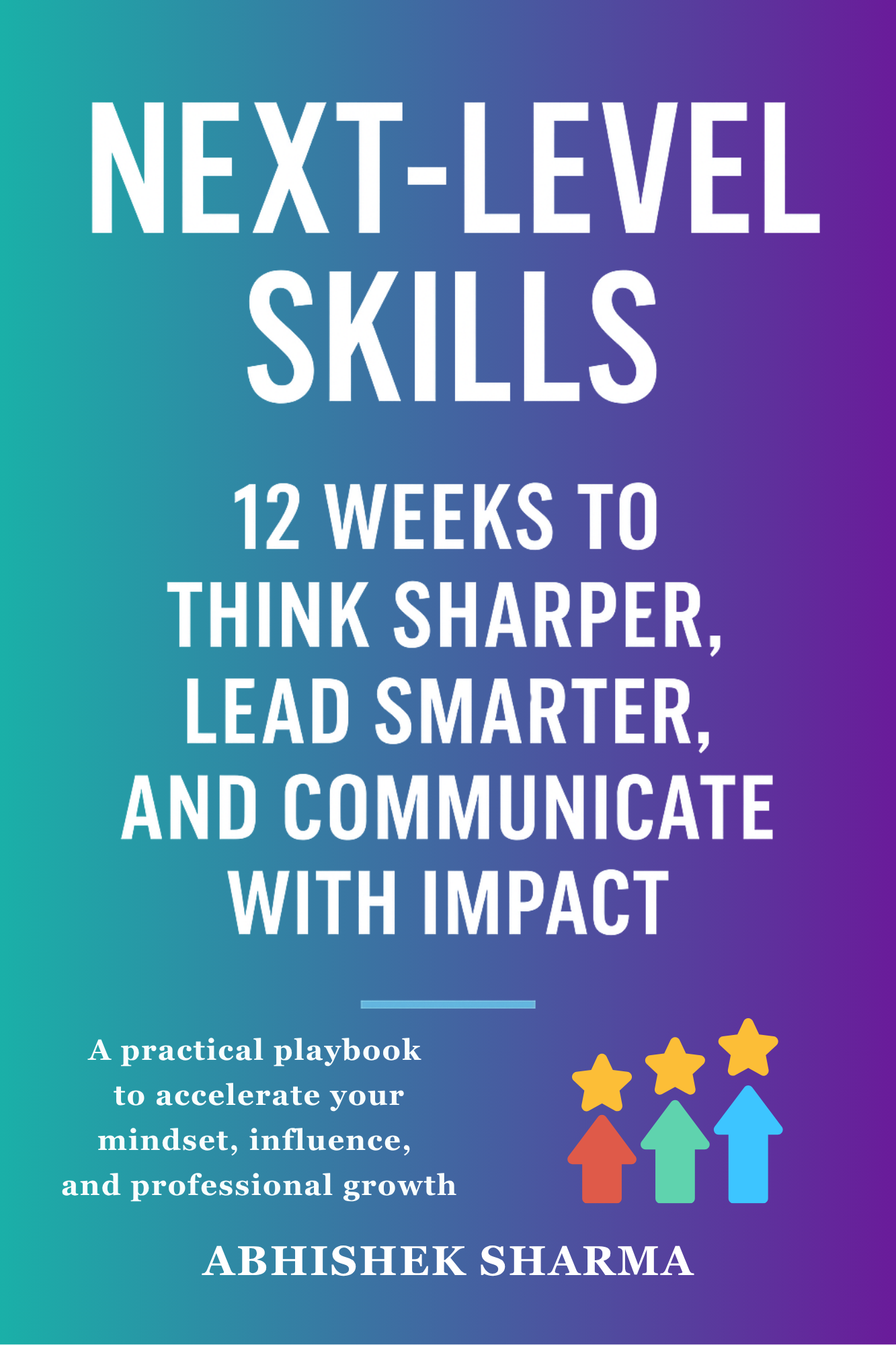
This and other essential skills are covered in Next-Level Skills — the book.
Learn more about the Book →A Reflection for This Month
Think about a habit or belief that has served you well for years.
Reflection Questions
The answers to those questions often reveal more about our leadership than any single achievement does.
Some Final Thoughts...
Unlearning rarely feels like progress while you're doing it. It feels like losing something familiar.
The leaders who keep growing are the ones who stay curious enough to ask, regularly, what it might be time to put down.
"What got you here won't get you there."
— Marshall Goldsmith
That willingness, practiced quietly and on purpose, is what unlearning really is. And ultimately, it is what makes room for the next level of who we can become.
Until Next Month, make room for what's next.
Abhishek
Founder & CEO, LegiQ | Building Intelligent Edge Hardware
Apply These Skills
- ✓Put the frameworks into practice this month.
- ✓Use the reflection prompts inside the book.
- ✓Build habits that compound over time.
This and other essential skills are covered in Next-Level Skills — the book.
Learn more about the Book →Enjoyed this edition?
Get the next one in your inbox — first week of every month.