Self-Awareness
Self-Awareness: The Key to Unlocking Our Full Potential
Welcome back to another edition of Next-Level Skills. Each edition, we explore the human and leadership capabilities that help us navigate work and life more effectively. Skills that move beyond theory and into practical application.
A warm welcome to everyone who has joined our community since the last edition. Whether you've been with us since the beginning or have recently discovered the newsletter or the book, thank you for being part of this journey.
This week, we focus on Self-Awareness, a skill that acts as the foundation for personal growth, emotional intelligence, and effective decision-making. The better we understand ourselves — our strengths, blind spots, emotions, and motivations — the more intentional and impactful our actions become.
The Moment of Realisation That Changed Everything
A few years ago, I was leading a team on a high-pressure project when I started noticing a pattern — I would frequently push for aggressive deadlines, assuming everyone operated at the same pace I did. The team was delivering results, but I sensed tension, and engagement seemed to be dropping.
One day, after a particularly rushed project phase, a team member hesitated before saying, “We always get things done, but sometimes it feels like we don’t have space to explore better ways.” That comment struck a chord. I had been so focused on efficiency that I had overlooked how my leadership style impacted the team’s dynamic.
I took a step back and started observing my own behaviour. I sought feedback, reflected on my tendencies, and realised I was unintentionally creating an environment where speed was prioritised over thoughtful collaboration. Adjusting my approach led to a more open, engaged, and motivated team.
What is Self-Awareness?
Self-awareness is the ability to objectively assess our emotions, thoughts, and behaviours and understand how they influence our interactions and decisions. It’s about recognising our strengths and weaknesses, uncovering unconscious biases, and developing a clearer sense of purpose.
Self-awareness is the ability to monitor our own emotions and reactions.
— Daniel Goleman, a pioneer in emotional intelligence
It’s a continuous process of reflection and adjustment that allows us to align our actions with our values.
Why Self-Awareness Matters
Developing self-awareness isn’t just about personal growth — it’s a critical skill that influences leadership, decision-making, and emotional intelligence. Here’s why it’s essential:
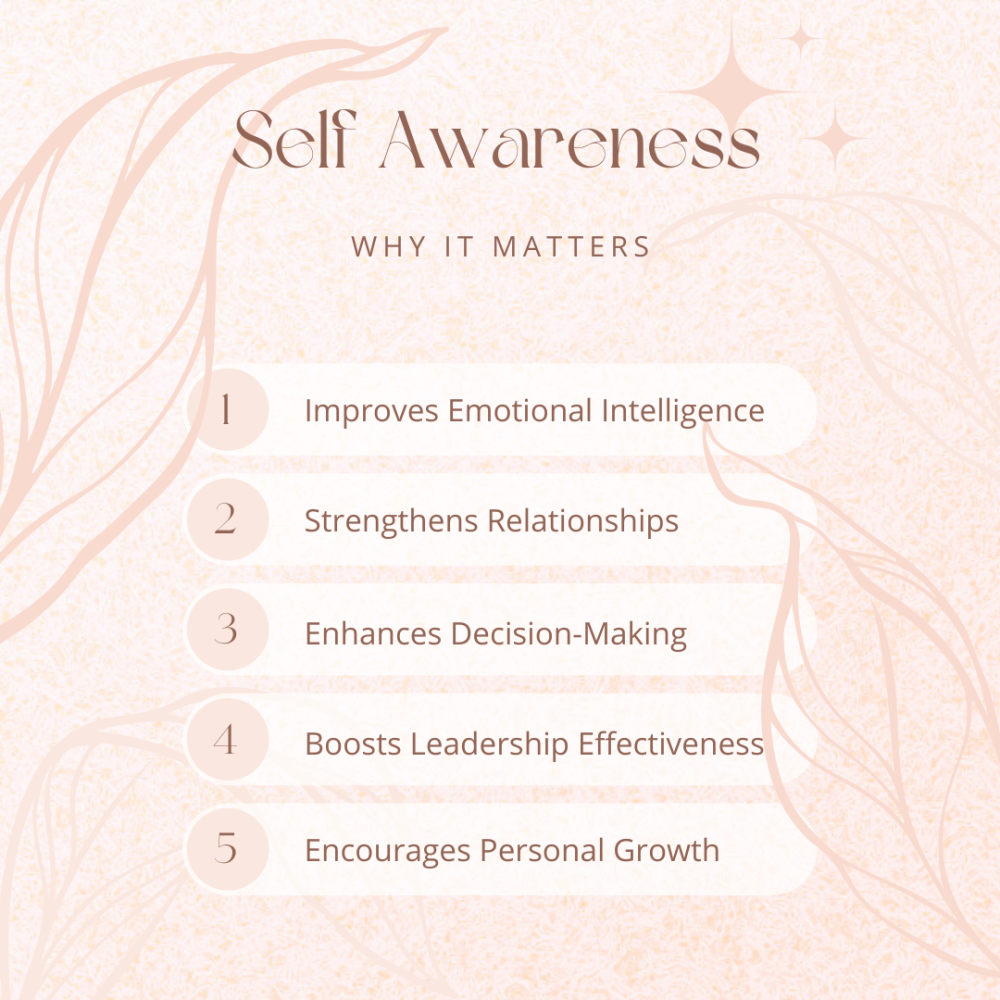
- 1Improves Emotional IntelligenceRecognising our emotions allows us to regulate them effectively and respond thoughtfully rather than react impulsively.
- 2Strengthens RelationshipsWhen we understand our communication style and its impact, we create more meaningful and productive interactions.
- 3Enhances Decision-MakingSelf-aware individuals can identify personal biases and make more objective choices.
- 4Boosts Leadership EffectivenessGreat leaders have a deep understanding of their strengths, weaknesses, and how they inspire or challenge others.
- 5Encourages Personal GrowthKnowing our limitations and patterns helps us continuously improve and adapt to new challenges.
The Two Types of Self-Awareness
Self-awareness is not just about looking inward — it’s also about understanding how we are perceived by others. To truly master this skill, we need to develop both internal and external self-awareness. Striking a balance between the two is key to personal and professional growth.
Internal Self-Awareness
Understanding our emotions, motivations, and values, and recognising how they shape our thoughts and behaviours.
External Self-Awareness
Understanding how others perceive us and how our actions influence those around us.
Developing both internal and external self-awareness allows us to align our actions with our intentions while building meaningful connections with others. When we cultivate this dual awareness, we enhance not only our self-leadership but also our ability to collaborate effectively.
With this foundation in place, let’s explore some practical strategies to strengthen our self-awareness in daily life.
Pro Tips for Strengthening Self-Awareness
Self-awareness is not something we achieve overnight — it’s a skill that requires continuous effort and intentional practice. The more we understand our thoughts, emotions, and behaviours, the better we can navigate challenges, make informed decisions, and build strong relationships.
By incorporating specific strategies into our daily routines, we can develop a deeper sense of awareness that enhances both personal and professional growth. Let us have a look —
Engage in Regular Reflection
Set aside time each day or week to reflect on your emotions, actions, and decisions. Journaling or silent contemplation can provide powerful insights.
Pro Tip: At the end of each workday, write down one moment where you felt at your best and one where you could have handled things differently.
Seek Constructive Feedback
We often have blind spots that others can see more clearly. Ask for honest feedback from trusted colleagues, mentors, or friends.
Pro Tip: Ask a colleague, “What’s one thing I do well in team settings, and what’s one thing I could improve?” and be open to their response.
Observe Your Emotional Triggers
Identify patterns in your emotional responses — what situations make you feel defensive, frustrated, or motivated? Awareness of these triggers allows for better control.
Pro Tip: If meetings with senior leaders make you anxious, analyse why. Is it fear of judgment, lack of preparation, or something else? Understanding the root cause allows for improvement.
Understand Your Strengths and Weaknesses
Knowing where we excel and where we struggle allows us to leverage our strengths while actively working on areas that need improvement.
Pro Tip: If you are great at strategy but struggle with detail-oriented tasks, delegate accordingly while consciously improving attention to detail where necessary.
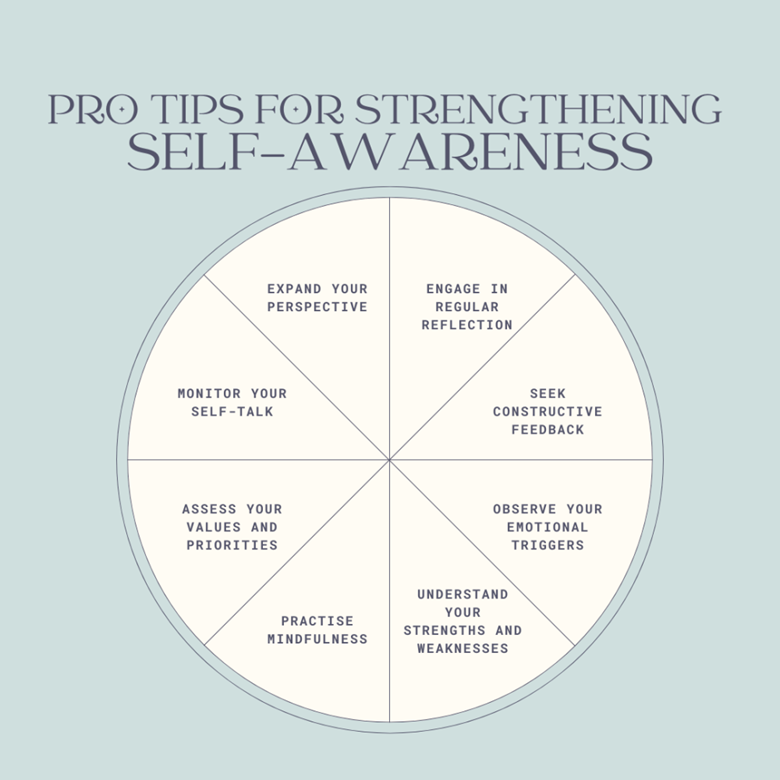
Practise Mindfulness
Being present in the moment enhances self-awareness by allowing us to observe our thoughts and emotions without judgment.
Pro Tip: Take a few minutes before important conversations to centre yourself, ensuring that you respond with clarity rather than emotion.
Assess Your Values and Priorities
Aligning decisions with personal and professional values ensures long-term fulfilment and consistency in behaviour.
Pro Tip: If work-life balance is important to you, assess whether your current commitments reflect that priority and make adjustments if needed.
Monitor Your Self-Talk
The way we speak to ourselves influences our confidence and mindset. Replace self-criticism with constructive, growth-oriented thinking.
Pro Tip: Instead of saying, “I’m terrible at presenting,” reframe it as, “I’m working on improving my presentation skills, and each experience makes me better.”
Expand Your Perspective
Challenge your assumptions by exposing yourself to different viewpoints and experiences.
Pro Tip: Read diverse perspectives on leadership, take on new challenges, or seek feedback from people outside your usual circle.
Strengthening self-awareness is an ongoing process that requires reflection, feedback, and a willingness to grow.
By consistently applying these strategies, we can gain a clearer understanding of ourselves and how we interact with the world.
Now, let’s take this a step further with a challenge designed to put these insights into action.
This and other essential skills are covered in Next-Level Skills — the book.
Learn more about the Book →A Challenge
Take 10 minutes at the end of each day to reflect on the following:
Reflection Questions
Some Final Thoughts...
Self-awareness is not just about knowing ourselves — it’s about continuously growing, adapting, and understanding our impact on the world around us. By developing self-awareness, we gain clarity, improve relationships, and make more thoughtful decisions.
Until you make the unconscious conscious, it will direct your life and you will call it fate.
— Carl Jung
The more aware we become, the more control we have over our actions and outcomes.
Thank you for being part of Next-Level Skills! I’d love to hear your thoughts — what has been the biggest self-awareness breakthrough in your journey? Let’s keep the conversation going.
Until Next Time,
Abhishek
Founder & CEO, LegiQ | Building Intelligent Edge Hardware
What’s one self-awareness habit you’ve built that has improved your personal or professional life?
What’s one insight you’ve gained about yourself recently, and how has it changed your approach?
How can we cultivate external self-awareness without becoming overly self-conscious?
What strategies help you stay mindful of your emotions in high-pressure situations?
Have you ever received surprising feedback about yourself? How did you respond?
What role does self-awareness play in effective decision-making?
How do we balance self-awareness with self-acceptance?
How does self-awareness impact leadership and team dynamics?
Have you ever had a moment where self-awareness completely shifted your perspective?
How do we use self-awareness to navigate workplace relationships more effectively?
Buy the Book
- ✓Learn the full Next-Level Skills framework.
- ✓Build clarity, influence, and decision-making strength.
- ✓Accelerate your personal and professional growth.
This and other essential skills are covered in Next-Level Skills — the book.
Learn more about the Book →This edition is reserved for supporters
Subscribe free, then unlock every past edition with just 1 successful referral.
Subscribe Free →Enjoyed this edition?
Get the next one in your inbox — first week of every month.