Summarisation
Next-Level Skills: The Power of Less - Mastering the Art of Summarisation
Welcome back to another edition of Next-Level Skills. Each edition, we explore the human and leadership capabilities that help us navigate work and life more effectively. Skills that move beyond theory and into practical application.
A warm welcome to everyone who has joined our community since the last edition. Whether you've been with us since the beginning or have recently discovered the newsletter or the book, thank you for being part of this journey.
Today, we’re tackling an underrated superpower: Summarisation. It’s not just about reducing words — it’s about refining meaning, sharpening clarity, and communicating like a leader.
The 2-Minute Pitch That Landed a Big Break
A few years ago, a colleague of mine attended a last-minute networking event. Just before walking in, she rehearsed a short two-minute version of her project pitch. Nothing fancy, just crystal-clear, value-packed, and audience-focused.
She ran into a senior executive from a global firm, struck up a conversation, and nailed her concise pitch. One week later? She had a seat at a decision-making table.
That two-minute summary? It unlocked a multi-million-dollar partnership.
In today’s world of noise and speed,
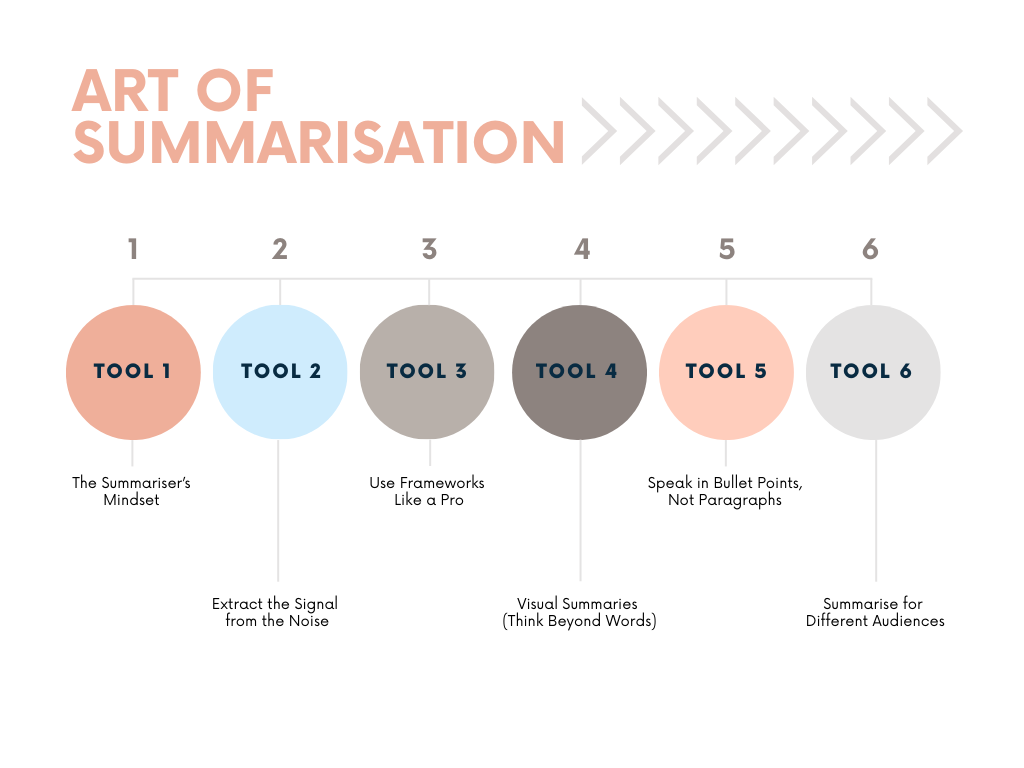
Tool 1: The Summariser’s Mindset
Before we talk tactics, we need the right frame of mind. Summarisation isn’t about dumbing down — it’s about distilling insight.
We need to stop equating long with smart. In fact, the more we know, the shorter we should speak.
If I had more time, I would have written a shorter letter.
— Blaise Pascal
A true summariser sees themselves not as a word-cutter, but a meaning curator. We don’t just remove fluff; we extract essence.
Tool 2: Extract the Signal from the Noise
Summarisation is like mining for gold — we sift through dirt to find value. But that means we need a method for what to keep and what to skip.
Pro Tip 1:
Identify the "Core Idea" first. Everything else — examples, metaphors, data — is there to support it. We ask: If this sentence disappeared, would the main idea still make sense?
Pro Tip 2:
Use highlighters (digitally or on paper) when consuming content. One colour for main ideas, one for supporting detail. Patterns emerge fast.
Tool 3: Use Frameworks Like a Pro
A framework is a friend to every great summariser. It provides structure, prioritisation, and logic.
Pro Tip:
Use frameworks like:
• What? So What? Now What?
• Problem → Cause → Solution
• 3-Point Summaries (e.g. Insight, Impact, Action)
Frameworks help us organise thoughts and guide listeners or readers through a journey. And once our logic is set, we can even go visual.
Tool 4: Visual Summaries (Think Beyond Words)
Sometimes the most effective summary isn’t verbal — it’s visual. Diagrams, mind maps, infographics, and even Post-it note clusters can clarify complexity fast.
Pro Tip 1:
Turn a meeting’s key takeaways into a visual sketch. It boosts retention and team alignment instantly.
Pro Tip 2:
Use simple shapes — boxes for ideas, arrows for flow, circles for connection. Even basic visuals can unlock big comprehension.
Tool 5: Speak in Bullet Points, Not Paragraphs
Most professionals ramble because they haven’t thought in bullets. Bullet points force focus.
Pro Tip 1:
Before speaking in a meeting, pause and mentally list 3 bullets. Then say: “Here are the top three things to know…” Instant clarity.
Pro Tip 2:
Use transitions like “First… Second… Finally…” to keep listeners anchored.
Tool 6: Summarise for Different Audiences
Summarising well means tailoring our message. What matters to the CEO won’t match what matters to a junior analyst.
Pro Tip 1:
Ask: “What does this audience care about?” Then deliver only what’s most relevant to them.
Pro Tip 2:
Build a “Summary Bank” — saved templates for stakeholders (e.g., 2-line summaries for execs, deeper dives for team leads).
This and other essential skills are covered in Next-Level Skills — the book.
Learn more about the Book →A Challenge
This week, try these three actions to hone the skill:
Reflection Questions
Some Final Thoughts...
Summarisation isn’t about saying less. It’s about saying the right things — with purpose, precision, and impact.
If you can’t explain it simply, you don’t understand it well enough.
— Albert Einstein
Let’s not just be informed — let’s be understood.
Until Next Time,
Abhishek
Founder & CEO, LegiQ | Building Intelligent Edge Hardware
When have we seen a poor summary derail a decision or meeting?
What’s one thing we’ve learned to explain better through summarisation?
What could we remove from our next email to make it better?
How often do we consider our audience before sharing updates?
Do we speak in essays or bullet points?
Who do we admire for their clarity of communication and why?
How do we summarise our week in 3 key wins?
Can we turn our next presentation into a visual one-pager?
What’s the shortest way we can explain our job to a stranger?
Are our meeting notes actually actionable?
Buy the Book
- ✓Learn the full Next-Level Skills framework.
- ✓Build clarity, influence, and decision-making strength.
- ✓Accelerate your personal and professional growth.
This and other essential skills are covered in Next-Level Skills — the book.
Learn more about the Book →This edition is reserved for supporters
Subscribe free, then unlock every past edition with just 1 successful referral.
Subscribe Free →Enjoyed this edition?
Get the next one in your inbox — first week of every month.