Assertiveness
The Quiet Strength of Being Assertive
Welcome back to another edition of Next-Level Skills. Each edition, we explore the human and leadership capabilities that help us navigate work and life more effectively. Skills that move beyond theory and into practical application.
A warm welcome to everyone who has joined our community since the last edition. Whether you've been with us since the beginning or have recently discovered the newsletter or the book, thank you for being part of this journey.
This week, we’re unpacking a skill that often walks a fine line - Assertiveness.
Misunderstood as aggressiveness or overshadowed by passivity, true assertiveness is neither.
It’s clarity. It’s confidence.
And it’s one of the most strategic forms of emotional intelligence.
When I Didn’t Speak Up and It Cost Us
Early in my career, I sat in a project review where a senior stakeholder proposed a change that I knew would derail our timeline. Everyone nodded. I stayed silent.
Why? Because I didn’t want to be seen as difficult. I convinced myself it wasn’t my place. But two weeks later, the impact unfolded exactly as I had feared. The project hit delays. Trust was strained. And the worst part? I knew I could have helped prevent it.
That moment taught me a key leadership lesson: Being silent can be riskier than speaking up.
Assertiveness is not about being loud. It’s about showing up for the outcome.
Why Assertiveness Is the Backbone of Influence
Assertiveness is the ability to express our thoughts, needs, and boundaries clearly and respectfully. It’s not about dominating the room. It’s about owning our voice without minimising someone else’s.
In fast-paced, feedback-heavy environments, assertiveness builds trust. It helps us communicate with clarity, reduce misunderstanding, and model strength without force.
Clear is kind. Unclear is unkind.
— Brené Brown
Assertiveness brings clarity to the table. And clarity is a powerful accelerant for collaboration.
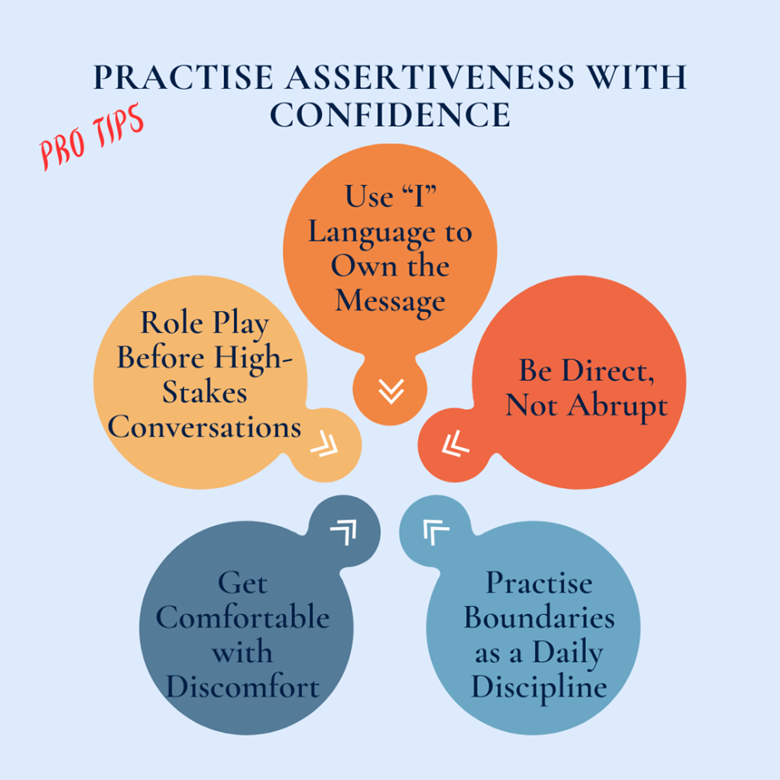
1. Use “I” Language to Own the Message
Pro Tip: When sharing feedback or a perspective, start with “I think” or “I’ve noticed” rather than placing blame.
This centres our message without putting others on the defensive. It invites discussion instead of triggering conflict.
2. Be Direct, Not Abrupt
Pro Tip: Say what needs to be said, but frame it with warmth. Swap vague cues like “Maybe we should…” with “I recommend we…” or “Let’s consider this option…”.
Assertiveness is about reducing ambiguity while preserving respect.
3. Practise Boundaries as a Daily Discipline
Pro Tip: Saying no is a muscle. Start by setting small boundaries and communicating them kindly but firmly.
The more we honour our limits, the more others will too.
4. Get Comfortable with Discomfort
Pro Tip: Assertive moments rarely feel smooth. Expect tension, not as failure, but as growth.
A short-term discomfort often leads to long-term clarity. Leaning in builds courage and capacity.
5. Role Play Before High-Stakes Conversations
Pro Tip: Before giving feedback or raising a tough point, practise the conversation with a colleague or mentor.
Rehearsing increases precision and confidence. Preparation makes assertiveness feel more natural and less reactive.
This and other essential skills are covered in Next-Level Skills — the book.
Learn more about the Book →A Challenge
Try one or more of these practical assertiveness exercises:
Reflection Questions
Some Final Thoughts...
Being assertive isn’t about being louder. It’s about being grounded in what we stand for, what we need, and how we lead with integrity.
No one can make us feel inferior without our consent.
— Eleanor Roosevelt
Assertiveness helps us move through the world with clarity, without apology.
Let’s commit to using our voice : not for volume, but for value.
Until Next Time,
Abhishek
Founder & CEO, LegiQ | Building Intelligent Edge Hardware
In what situations do we need to practise courage over comfort?
How can we prepare for tough conversations without becoming defensive?
What does healthy assertiveness look like in our workplace culture?
Are we communicating clearly — or expecting others to read between the lines?
When was the last time we said yes when we meant no?
What boundaries do we need to reinforce this week?
How often do we overexplain when saying no?
What would happen if we viewed feedback as a form of clarity, not confrontation?
Do we mistake assertiveness for rudeness or conflict? Why?
Where in our professional life are we holding back our honest opinion out of fear?
Apply These Skills
- ✓Put the frameworks into practice this month.
- ✓Use the reflection prompts inside the book.
- ✓Build habits that compound over time.
This and other essential skills are covered in Next-Level Skills — the book.
Learn more about the Book →This edition is reserved for supporters
Subscribe free, then unlock every past edition with just 1 successful referral.
Subscribe Free →Enjoyed this edition?
Get the next one in your inbox — first week of every month.