Clarity in Messaging
Say What You Mean: The Power of Clarity in Messaging
Welcome back to another edition of Next-Level Skills. Each edition, we explore the human and leadership capabilities that help us navigate work and life more effectively. Skills that move beyond theory and into practical application.
A warm welcome to everyone who has joined our community since the last edition. Whether you've been with us since the beginning or have recently discovered the newsletter or the book, thank you for being part of this journey.
This week’s focus: Clarity in Messaging.
In an age of endless noise, clarity isn’t just useful. It’s a competitive advantage. Let’s explore how to master it.
When Everyone Nodded, But No One Understood
Several years ago, I led a project kick-off with stakeholders across four departments. I’d worked hard on my presentation: detailed, thorough, data-backed. I wrapped up, asked for questions, and got blank stares followed by polite nods
A week later, two teams built solutions based on completely different interpretations of what I’d said. We lost time, we lost momentum.
And I learnt a powerful truth:
That experience changed everything for me. Clarity became non-negotiable. Not just in documents and decks but also in emails, meetings, chats, and check-ins.
Why Clarity Beats Complexity
In fast-paced environments, ambiguity is costly. We assume clarity is innate but it’s a discipline. A practice, to be more accurate.
Clear communication builds trust, reduces friction, and makes teams more agile. Unclear messaging, on the other hand, creates confusion, rework, and silence where there should be action.
The single biggest problem in communication is the illusion that it has taken place.
— George Bernard Shaw
To break this illusion, we need to sharpen how we speak, write, and frame ideas, especially when things are complex.
Three Pillars of Clear Messaging
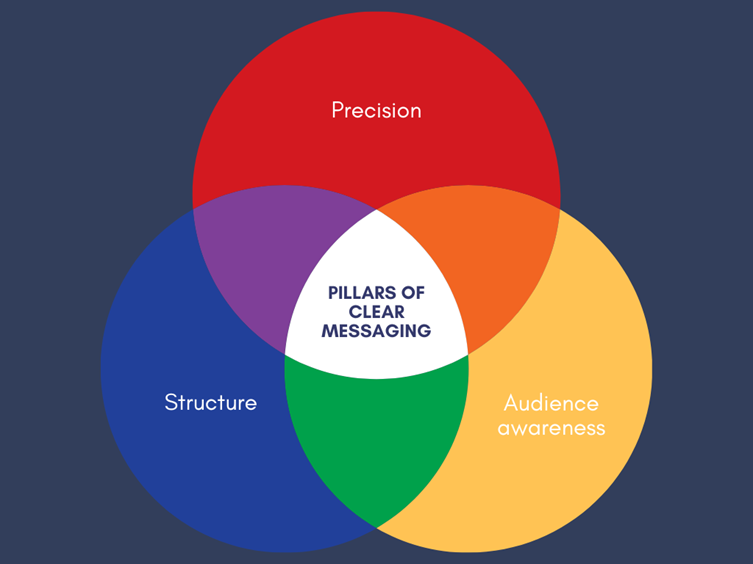
Strong messaging lives at the intersection of
1. Say Less, Mean More
Brevity forces us to distil. And distillation is how we surface the essence of our message.
Pro Tip: Before writing or speaking, ask, “What’s the one thing I want them to walk away with?” Write it down. Then build around it. Not above it.
2. Structure Is a Service
Structure doesn’t limit creativity, it delivers it. A strong flow helps others follow our logic and absorb our ideas.
Pro Tip: Use tested models like “Point – Evidence – Call to Action” or “Why – What – How.” Always give the summary up front, then go deeper if needed.
3. Speak in Their Language
What’s clear to us may be jargon to others. Great communicators meet their audience where they are.
Pro Tip: Tailor messages by removing assumptions. If we’re addressing execs, lead with impact. If we’re speaking to technical teams, lead with context. If we’re emailing clients, lead with empathy.
Common Clarity Killers (and How to Beat Them)
Let’s look at some usual suspects that dilute our messaging and how to disarm them.
Vague Words: "Soon", "ASAP", "Let's sync"
• Pro Tip: Replace with specifics: "By 3pm Friday", "by close of business today", or "15-min call Tuesday morning?"
Overexplaining: We often try to cover all bases and lose people halfway, in the process.
• Pro Tip: Start with the high-level message. Let others ask for detail if needed.
Buried Leads: Key points hidden at the end.
• Pro Tip: Flip it. Lead with the conclusion. Then justify it.
Messaging in Action: Everyday Opportunities
We often think of “messaging” as something for presentations or branding. But it’s everywhere:
- →The way we reply in Teams or Slack
- →The tone in our calendar invites
- →The subject line in an email
- →The intro in a 1:1
- →The update in a team huddle
Each is a chance to reduce noise and create clarity.
Clear is kind. Unclear is unkind.
— Brené Brown
This and other essential skills are covered in Next-Level Skills — the book.
Learn more about the Book →A Challenge
Here’s how to practise clarity in the next 7 days:
Reflection Questions
Some Final Thoughts...
In a world full of input, clarity stands out. It’s not just about getting things done, it’s about helping others do their best work without second-guessing.
When we practise clarity, we lead better meetings, write stronger emails, deliver tighter updates, and build trust faster.
Until Next Time,
Abhishek
Founder & CEO, LegiQ | Building Intelligent Edge Hardware
When was the last time a message we thought was clear turned out not to be?
What’s the difference between being concise and being abrupt?
How do we tailor messages across levels - execs vs peers vs clients?
What’s one jargon phrase we could retire from our daily communication?
How do we encourage clarity without stifling creativity?
Have we seen examples where lack of clarity cost a project or relationship?
Do we ask others to reflect back what they heard - especially in high-stakes convos?
How can we model clarity for newer team members?
What systems (templates, rituals) help us drive consistent clarity?
What does “clarity as a leadership trait” mean in our current context?
Buy the Book
- ✓Learn the full Next-Level Skills framework.
- ✓Build clarity, influence, and decision-making strength.
- ✓Accelerate your personal and professional growth.
This and other essential skills are covered in Next-Level Skills — the book.
Learn more about the Book →This edition is reserved for supporters
Subscribe free, then unlock every past edition with just 1 successful referral.
Subscribe Free →Enjoyed this edition?
Get the next one in your inbox — first week of every month.