Boundary Setting
The Power of No: Why Boundaries Make Us Better
Welcome back to another edition of Next-Level Skills. Each edition, we explore the human and leadership capabilities that help us navigate work and life more effectively. Skills that move beyond theory and into practical application.
A warm welcome to everyone who has joined our community since the last edition. Whether you've been with us since the beginning or have recently discovered the newsletter or the book, thank you for being part of this journey.
This week, we’re exploring a soft skill that’s often misunderstood as a barrier but is, in truth, a bridge: Boundary Setting.
“I Can’t Keep Doing This”
A few years ago, I found myself saying yes to everything: urgent meetings, weekend emails, last-minute projects. I wore my responsiveness like a badge of honour until it wore me down.
One Thursday evening, after a 13-hour day, I opened my laptop to catch up on admin, and my calendar auto-refreshed. It showed back-to-back bookings for the next six days. I closed the lid and said out loud, “I can’t keep doing this.”
The next day, I took a deep breath and sent three emails: one to renegotiate a deadline, one to opt out of a non-essential committee, and one to my team explaining I’d be offline from 6pm that evening and every evening after.
Nothing broke. In fact, things worked better.
Boundaries hadn’t made me weaker. They’d made me clearer, calmer, and more focused.
Boundaries: The Quiet Engine Behind High Performance
We often associate high performers with hustle, but the most consistent and creative people aren’t the ones working longest - they’re the ones working clearest.
Boundaries help us preserve our energy, protect our priorities, and signal how we wish to be treated. They aren’t rigid walls. They’re flexible structures that guide where we end and where the work begins.
Boundaries teach people how to treat you
— Cheryl Strayed
Let’s learn how to teach that lesson with confidence and care.
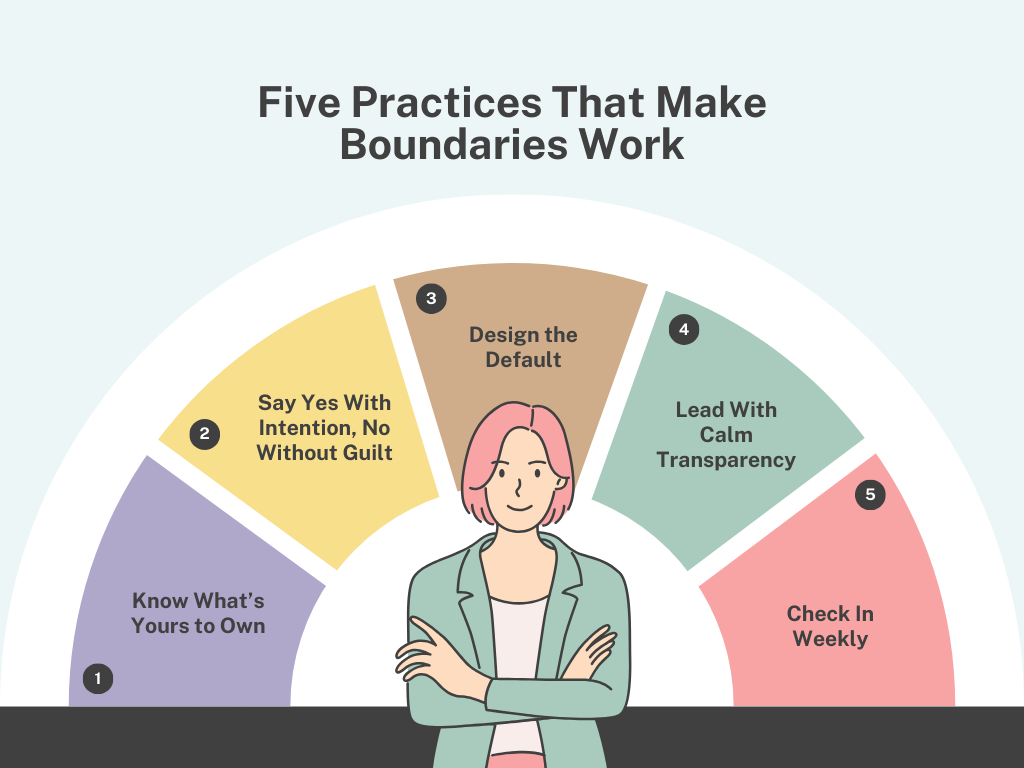
1. Know What’s Yours to Own
Before we set boundaries, we must first recognise what truly belongs to us.
Pro Tip: Map out your responsibilities, time blocks, and values. If something doesn’t serve these, it’s a candidate for release.
2. Say Yes With Intention, No Without Guilt
Most of our boundaries collapse under the weight of approval-seeking.
Pro Tip: Replace “I don’t have time” with “This isn’t aligned right now.” Let clarity (not guilt!) be our compass.
3. Design the Default
Boundaries shouldn’t rely on willpower alone, they should be embedded in our systems.
Pro Tip: Use calendar blocks, email signatures, and shared availability settings to make our limits visible by default.
4. Lead With Calm Transparency
Boundaries don’t have to be hard lines, they can be gentle truths.
Pro Tip: Share the why behind our boundary. For example: “To stay focused on delivery, I’ve blocked mornings for deep work. Let’s chat after 1pm?”
5. Check In Weekly
Boundaries are dynamic. As life evolves, so must they.
Pro Tip: Reflect weekly: “Where did I feel stretched too thin?” That’s where a new boundary may need to emerge.
This and other essential skills are covered in Next-Level Skills — the book.
Learn more about the Book →A Challenge
Boundary building is like strength training: it starts small, grows over time, and pays off when it matters most.
Reflection Questions
Some Final Thoughts...
Boundary setting is not about becoming unavailable. It’s about being fully present where it matters most.
When we honour our limits, we amplify our impact. When we draw a line, we make space for depth. And when we say no clearly, we say yes to the right things fully, and with freedom.
The art of leadership is the art of being yourself, at full stretch.
— poet David Whyte
But we cannot stretch without also knowing when to stop - can we?
Let’s lead with limits. And let’s make space to breathe, build, and be.
Until Next Time,
Abhishek
Founder & CEO, LegiQ | Building Intelligent Edge Hardware
Are we rewarding overextension in our teams or modelling sustainability?
What would life feel like if our calendar reflected our values not just our obligations?
What is one boundary we know we need to set but have been avoiding?
What part of our calendar feels most draining, and why?
How can we communicate boundaries without sounding defensive or apologetic?
Do we fear being seen as selfish if we protect our time?
What might improve in our relationships if we were clearer about our limits?
When was the last time we felt truly present and what boundary enabled that?
How do we react when others set boundaries with us, do we honour them or feel rejected?
In what ways do our systems help or hinder our boundaries?
Gift the Book
- ✓A colleague stepping into leadership.
- ✓A team member navigating change.
- ✓A friend looking to take their next step professionally.
This and other essential skills are covered in Next-Level Skills — the book.
Learn more about the Book →This edition is reserved for supporters
Subscribe free, then unlock every past edition with just 1 successful referral.
Subscribe Free →Enjoyed this edition?
Get the next one in your inbox — first week of every month.