Emotional Regulation
Staying Calm When It Counts Most
Welcome back to another edition of Next-Level Skills. Each edition, we explore the human and leadership capabilities that help us navigate work and life more effectively. Skills that move beyond theory and into practical application.
A warm welcome to everyone who has joined our community since the last edition. Whether you've been with us since the beginning or have recently discovered the newsletter or the book, thank you for being part of this journey.
Today, in the 39th edition, we will lead ourselves into the important topic of Emotional Regulation, especially when we need it the most!
When the Storm Hit the Room
It was a Monday morning meeting that should have been routine. The agenda was clear, the room was set, the coffee was hot. But halfway through, a heated disagreement broke out between two senior team members over a budget decision. The tension spiked, voices rose, and all eyes turned to me.
In that moment, my first instinct was to push back, defend my position and match their energy.
But I paused, took a slow breath and spoke in an even tone.
I acknowledged both perspectives without taking sides, reframed the conversation toward the shared objective and set a follow-up discussion to resolve the specifics. By the end of the meeting, the room felt calmer, focused and respectful again.
Understanding Emotional Regulation
At its core, emotional regulation is our ability to recognise, manage and respond to emotions in a way that supports our goals. It does not mean suppressing emotions, nor does it mean letting them run unchecked. It is the balance between acknowledging how we feel and choosing the best way to act.
If you are tuned out of your own emotions, you will be poor at reading them in other people.
— Psychologist Daniel Goleman
This is why emotional regulation is so closely tied to leadership, influence and strong relationships.
The starting point is self-awareness - noticing when we are triggered and catching ourselves before reacting impulsively. The next step is intentionally choosing our response so that our actions align with both our values and the desired outcome.
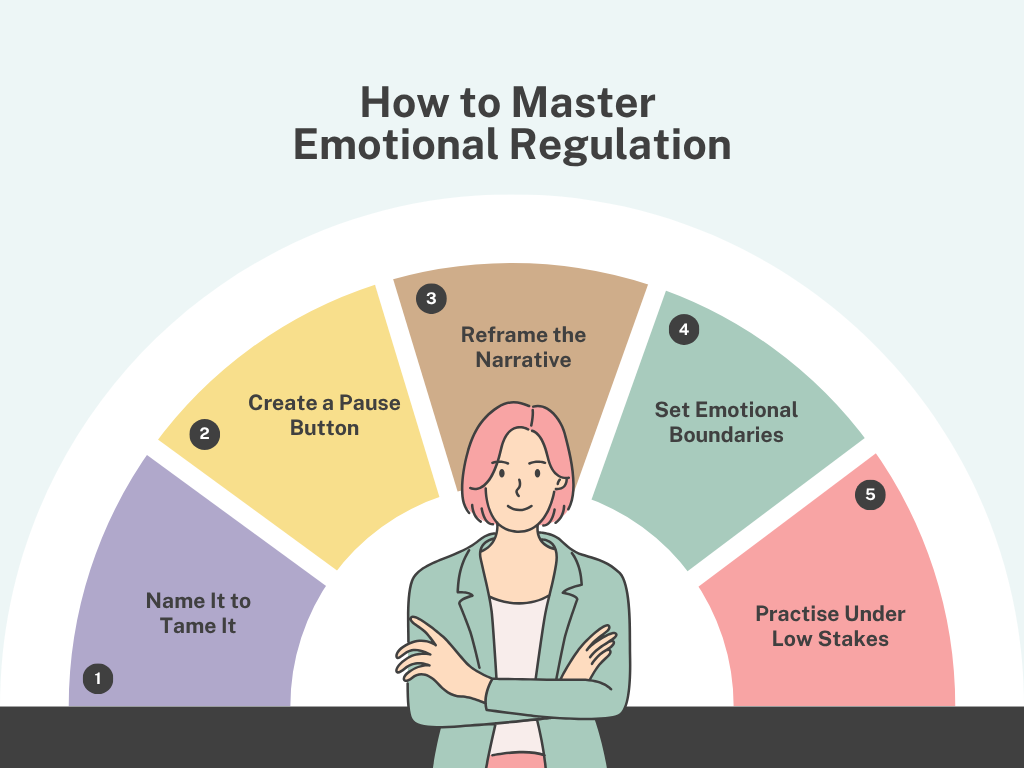
Name It to Tame It
When emotions run high, labelling them can reduce their intensity. For example, telling ourselves, “I’m feeling frustrated” helps us shift from being inside the emotion to observing it. This creates space for a more thoughtful response.
Pro Tip: Keep a short emotional vocabulary handy - words like frustrated, anxious, hopeful, optimistic - so we can quickly identify what is happening internally without judgment.
Create a Pause Button
In heated situations, even a few seconds of pause can prevent regrettable words or actions. It can be as simple as taking three slow breaths, asking a clarifying question or suggesting a short break before continuing.
Pro Tip: Pair the pause with a grounding action like pressing our feet into the floor or noticing the sensation of holding a pen. These physical cues help bring our focus back to the present.
Reframe the Narrative
Often, our emotional intensity comes from the story we tell ourselves about the situation. By reframing, we can view it from a different angle, more as a challenge instead of a threat, or more as a learning opportunity rather than a personal attack.
Pro Tip: When frustration builds, ask, “What else could be true here?” This question opens the door to alternative interpretations that soften our emotional charge.
Set Emotional Boundaries
Emotional regulation is also about knowing where our responsibility ends. We can empathise without absorbing someone else’s emotional state.
Pro Tip: Use phrases like “I can see this is important to you” to acknowledge the other person’s emotions, while mentally holding onto our own grounded state.
This and other essential skills are covered in Next-Level Skills — the book.
Learn more about the Book →A Challenge
The next time you feel a strong emotion rise - whether in a meeting, in an email or in a personal conversation - notice it, name it and choose a deliberate action that supports your longer-term goal.
Some Final Thoughts...
Emotional regulation is not about being unshakable at all times, but instead, it is about having the tools to navigate our feelings without letting them hijack our actions. In the workplace, it often underpins the difference between escalating a problem and steering it toward a solution.
Between stimulus and response there is a space. In that space is our power to choose our response. In our response lies our growth and our freedom.
— Viktor E. Frankl
When we can remain steady while others are reactive, we become the anchor that holds the team steady. And that steadiness earns trust, respect and influence over the long run.
Do you agree? Let me know in comments.
Until Next Time,
Abhishek
Founder & CEO, LegiQ | Building Intelligent Edge Hardware
What is the most challenging emotion for you to regulate in the workplace?
How do you usually notice the first signs that you are being triggered?
Have you ever seen emotional regulation turn a tense situation into a productive one?
What daily habits help you keep a calm and balanced mindset?How do you reframe a situation when frustration or anger sets in?
Have you noticed differences in how you regulate emotions in person vs online communication?
How do you prevent yourself from absorbing the emotional energy of others?
Can you recall a time when a pause changed the course of a conversation?
What role does empathy play in your emotional regulation approach?
How do you build emotional regulation skills in your team?
How do you reframe a situation when frustration or anger sets in?
Buy the Book
- ✓Learn the full Next-Level Skills framework.
- ✓Build clarity, influence, and decision-making strength.
- ✓Accelerate your personal and professional growth.
This and other essential skills are covered in Next-Level Skills — the book.
Learn more about the Book →This edition is reserved for supporters
Subscribe free, then unlock every past edition with just 1 successful referral.
Subscribe Free →Enjoyed this edition?
Get the next one in your inbox — first week of every month.