Curating & Synthesizing Ideas
The Art of Curating and Synthesising Ideas
Welcome back to another edition of Next-Level Skills. Each edition, we explore the human and leadership capabilities that help us navigate work and life more effectively. Skills that move beyond theory and into practical application.
A warm welcome to everyone who has joined our community since the last edition. Whether you've been with us since the beginning or have recently discovered the newsletter or the book, thank you for being part of this journey.
It has been 50 weeks, since we sat on this journey and learnt 50 different Next Level Skills together!
Today’s topic is one that sits at the intersection of creativity and clarity: Curating and Synthesising Ideas.
In a world flooded with information, the real skill is not just gathering ideas but making sense of them - turning noise into knowledge and insights into action.
When the Whiteboard Became a Maze
A few years ago, I was part of a strategy session where our team had to reimagine a client’s customer experience journey. Within an hour, the whiteboard looked like a modern art piece : colourful, chaotic, and confusing. Everyone had brilliant ideas, each one valid in isolation, yet collectively they resembled a tangled web of post-it notes and arrows.
We paused, stepped back, and realised something important: brainstorming was the easy part. However, the real challenge wasn’t coming up with ideas - it was making sense of them.
Which ideas truly mattered? Which were noise?
And more importantly, how could we connect them into a narrative that made sense to everyone in the room?
So, we began filtering.
We started grouping related thoughts, removing what didn’t align with our purpose, and reframing scattered suggestions into themes. Hours later, the mess started to take shape. The board that once looked like chaos now told a clear story : a vision that everyone could rally behind.
The whiteboard wasn’t a failure of creativity. It was a test of clarity.
And that’s where the real skill lies - not just in generating ideas, but in curating and synthesising them.
Because in an era overflowing with information, our ability to distil meaning from noise is what sets great thinkers apart.
The Power of Thought Curation
We live in an age of endless content - books, podcasts, articles, videos, posts. It’s tempting to consume everything, but consumption without curation leads to overwhelm.
Curation is about intentional selection : identifying the few ideas that truly resonate or solve a problem. It’s what separates thinkers from scrollers.
Creativity is just connecting things.
— Steve Jobs
The key is choosing which things to connect.
Curation gives structure to our curiosity. It helps us collect insights that align with purpose rather than randomness.
To make this practical, we must develop habits of capturing ideas as they appear and revisiting them with discernment.
Here are some practical tips that worked for me over years.
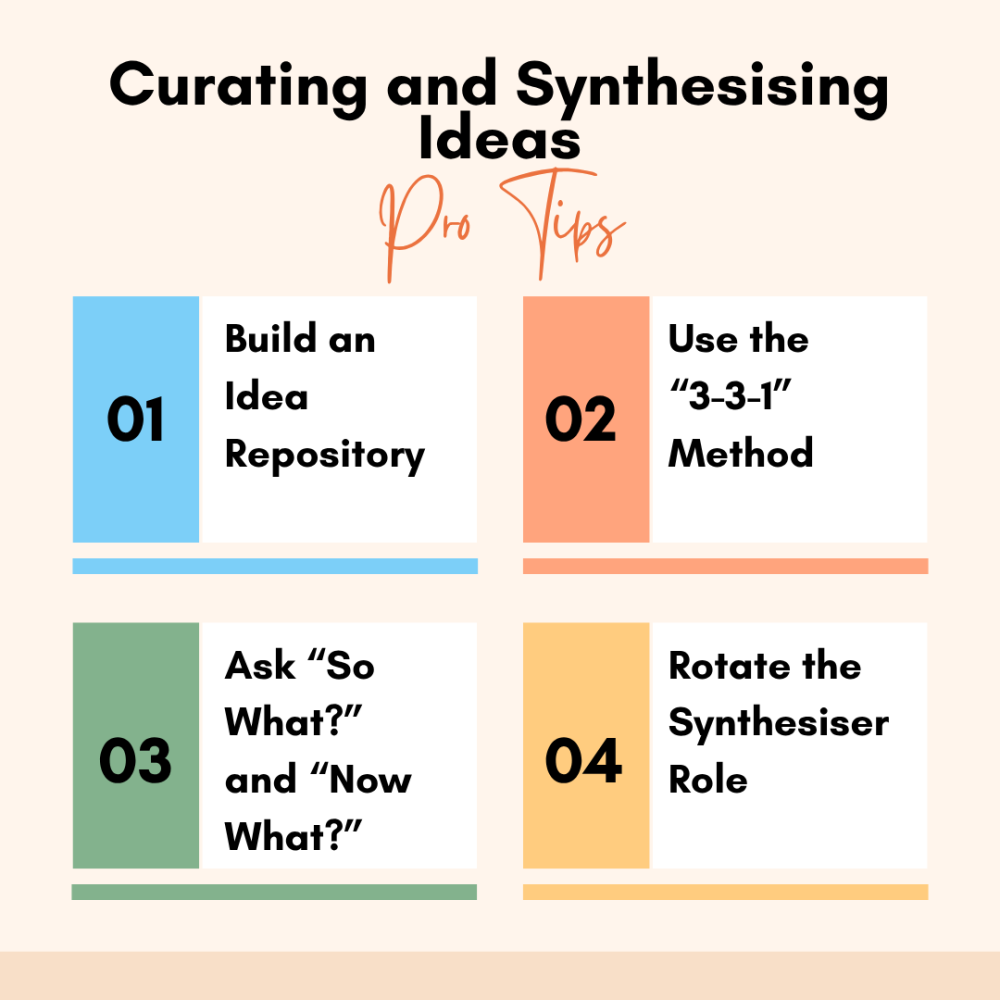
Pro Tip #1: Build an Idea Repository
Keep a single space for ideas, whether it’s a digital note, Notion board, or physical journal. Capture quotes, reflections, and questions, not just content. Over time, patterns will emerge that reveal what truly drives our curiosity.
From Information to Insight: The Skill of Synthesis
Synthesis is where magic happens.
It’s where we move from collecting insights to creating meaning. Anyone can gather information, but only reflective thinkers can combine ideas into something new and impactful.
The process involves stepping back to see connections - how ideas interact, complement, or even contradict one another. It’s the difference between reading ten articles and writing one paragraph that summarises them in a way no one has before.
The most original ideas often come from combining old ideas in new ways.
— Adam Grant, Organisational psychologist
And I cannot agree more! Having worked across various industries and domains, I have found that best practices in one, often are the ground breaking ideas in another!
When we master synthesis, we stop being passive consumers of information and start becoming creators of knowledge.
Pro Tip #2: Use the “3-3-1” Method
When exploring a topic, capture three main ideas, three supporting perspectives, and one key takeaway in our own words. This not only deepens understanding but forces synthesis - making the idea ours, not just borrowed.
Once we’ve learned to connect ideas meaningfully, the next challenge is deciding which ones to pursue.
Filtering for Relevance: The Leadership Edge
Great leaders don’t just gather insights - they know which ones matter right now. In teams and projects, this ability to prioritise insights drives focus and results.
Filtering is about alignment - connecting ideas to purpose, context, and timing. The best decision-makers are not necessarily the most informed, but the most discerning!
By curating ideas with purpose and synthesising with clarity, we make better strategic choices and communicate them more persuasively.
Pro Tip #3: Ask “So What?” and “Now What?”
After every brainstorming session or research deep dive, pause to ask:
- →So what does this actually mean?
- →Now what can we do with it?
These two questions transform information into insight and insight into action.
Curation and Synthesis in Teams
In collaborative environments, teams often drown in data and opinions. That’s where synthesis becomes a shared responsibility. It requires listening deeply, summarising ideas clearly, and framing them in ways that move conversations forward.
When we teach teams to curate collectively - focusing on what truly advances the mission - we create cultures that value both creativity and clarity.
Information is a source of learning. But unless it is organised, processed, and available to the right people in a format for decision making, it is a burden, not a benefit.
— William Pollard
Pro Tip #4: Rotate the Synthesiser Role
In group settings, assign someone to capture, summarise, and synthesise key points after discussions. This ensures ideas don’t get lost and builds collective clarity across diverse perspectives.
This and other essential skills are covered in Next-Level Skills — the book.
Learn more about the Book →A Challenge
This week, try curating ideas more intentionally. Pick one area you’ve been learning about and organise your notes into three insights, two patterns, and one action.
Reflection Questions
You’ll be surprised at how clarity multiplies creativity.
Some Final Thoughts...
In a noisy world, it’s not the loudest ideas that win, but the clearest. Curating and synthesising are not about cutting creativity, they’re about sharpening it.
Out of clutter, find simplicity. From discord, find harmony. In the middle of difficulty lies opportunity.
— Albert Einstein
The better we get at distilling ideas, the stronger our ability to lead, communicate, and create becomes.
Now over to you : what’s one idea we’ve recently connected in a way that changed our perspective?
Until Next Time,
Abhishek
Founder & CEO, LegiQ | Building Intelligent Edge Hardware
How do we ensure ideas lead to action, not just accumulation?
What’s one time when combining unrelated ideas led to a breakthrough?
What role does curiosity play in discovering connections between ideas?
How can teams balance creativity with clarity during brainstorming?
How can leaders teach teams to think in synthesis, not just silos?
How can we develop the habit of reflecting before we act on information?
What tools or methods help us organise ideas most effectively?
What’s the difference between collecting ideas and curating them?
How do we filter valuable insights from the flood of daily information?
How can synthesis improve decision-making and communication?
Gift the Book
- ✓A colleague stepping into leadership.
- ✓A team member navigating change.
- ✓A friend looking to take their next step professionally.
This and other essential skills are covered in Next-Level Skills — the book.
Learn more about the Book →This edition is reserved for supporters
Subscribe free, then unlock every past edition with just 1 successful referral.
Subscribe Free →Enjoyed this edition?
Get the next one in your inbox — first week of every month.