Positive Framing for Influence
Positive Framing for Influence
Welcome back to another edition of Next-Level Skills. Each edition, we explore the human and leadership capabilities that help us navigate work and life more effectively. Skills that move beyond theory and into practical application.
A warm welcome to everyone who has joined our community since the last edition. Whether you've been with us since the beginning or have recently discovered the newsletter or the book, thank you for being part of this journey.
Today, we explore a skill that shapes how people respond to us, how confidently they follow us, and how effectively we inspire action.
It is the skill of Positive Framing for Influence.
Positive framing is not about sugar-coating reality. It is about highlighting possibilities instead of limitations, opportunities instead of obstacles, and clarity instead of confusion. When used well, it helps us build trust, motivate others, and create forward momentum in the moments that matter most.
When a Team Was Stuck in the Problem
A few years ago, I was leading a project team that had just experienced a major setback. A critical feature failed during testing, and the room quickly filled with frustration. Every sentence began with “We cannot”, “We should have”, or “This ruins everything”.
The energy in the room was tense, and progress felt impossible. So I paused the conversation and reframed it.
Instead of asking, “Why did this happen”, I asked, “What can we still salvage, and how do we move forward from here”. That shift changed everything.
People who were stuck in blame moved to solution mode. Alternatives emerged. Creativity returned. The team left the room energised, not defeated.
That day reminded me of something simple but powerful.
The way we frame the situation becomes the way people experience it.
Your attitude, not your aptitude, will determine your altitude.
— Zig Ziglar
And our framing is the language of our attitude.
Why Positive Framing Matters
Positive framing helps us steer conversations, influence decision-making, and build psychological safety.
It shifts the focus from loss to learning, from fear to possibility, and from uncertainty to clarity. In fast-paced workplaces, framing is not just a communication technique. It is a leadership strategy.
A team that hears “We can figure this out” will behave very differently from a team that hears “This is a big problem”. The message shapes the mindset, and the mindset shapes the outcome.
How Positive Framing Influences Others
Positive framing works because it does three things simultaneously:
- 11. It reduces emotional resistancePeople feel safer and more open to ideas when the language focuses on solutions.
- 22. It widens perspectiveInstead of getting stuck on what is wrong, people begin noticing what is possible.
- 33. It builds shared confidenceWhen our framing is grounded in optimism and clarity, others start believing in the path forward.
Between stimulus and response, there is a space. In that space is our power to choose our response.
— Viktor Frankl
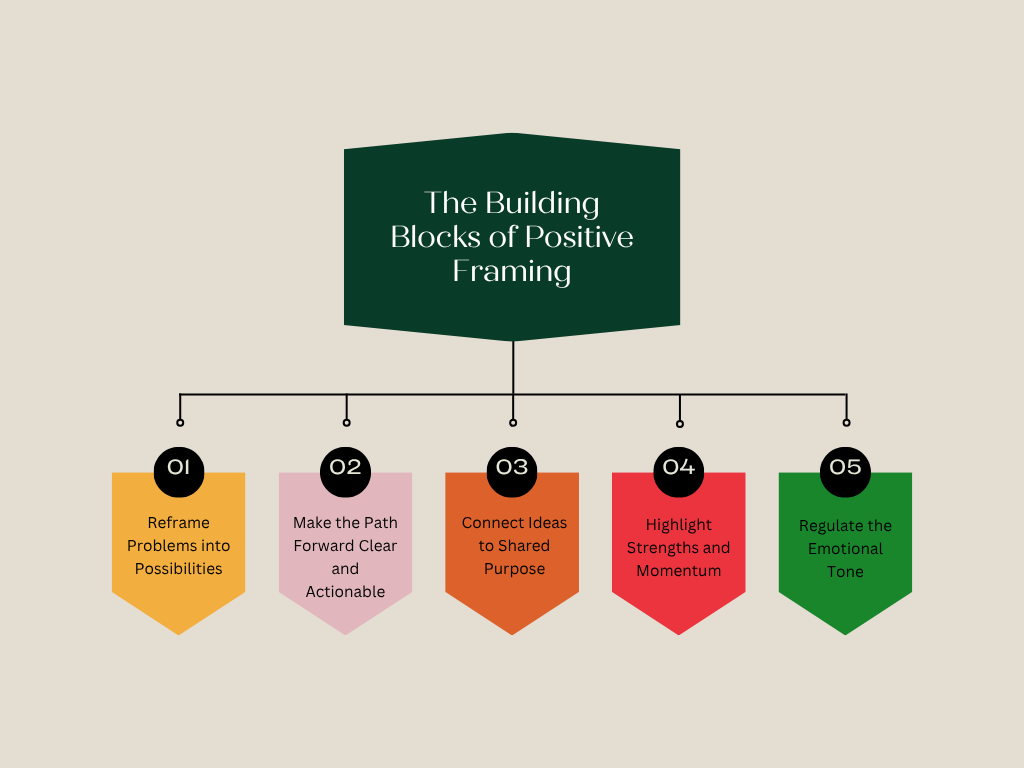
1. Reframe Problems into Possibilities
Many teams get stuck because conversations revolve around limits. Positive framing begins by asking what could work instead of what will not.
Pro Tip: When a challenge arises, try asking, “What is the opportunity here” or “What can we still achieve from this”. These questions shift the emotional tone and open the door to fresh thinking.
Once we learn to reframe problems into possibilities, the next step is to ensure our message provides clarity instead of confusion.
2. Make the Path Forward Clear and Actionable
Positive framing is not vague optimism. It must pair encouragement with clarity so people know exactly what comes next.
Pro Tip: Try replacing “We need to fix this” with “Let’s take these next two steps now”. It builds confidence and reduces overwhelm.
Once clarity is established, we can elevate the influence of our message by anchoring it in collective purpose.
3. Connect Ideas to Shared Purpose
People respond better when they see how their efforts contribute to something meaningful and collective. Linking a message to purpose creates alignment and sparks motivation.
Pro Tip: Use phrases like “Here is how this helps us achieve our goal” or “This moves us closer to what we committed to”. Purpose amplifies influence.
With purpose in place, the next layer of positive framing is about showing belief in the team’s capability.
4. Highlight Strengths and Momentum
Positive framing is more influential when it acknowledges what is already working. Recognition fuels confidence, and confidence fuels performance.
Pro Tip: Point out small wins, past successes, or specific strengths of the team. This builds belief and reduces anxiety.
When people feel valued and capable, they are more receptive to next steps and more resilient under pressure. This leads us to the role of emotional awareness.
5. Regulate the Emotional Tone
We cannot influence others positively if our own tone is defensive or reactive. Positive framing begins with emotional steadiness.
Pro Tip: If tension rises, pause for a few seconds before responding. This small moment helps us speak with intention rather than impulse.
Now that we have explored the foundations, let us look at how positive framing shows up in everyday leadership moments.
Real-World Moments Where Positive Framing Changes Everything
Positive framing plays out in small but meaningful ways:
When a deadline slips: Instead of “We are behind again”, try “We need to adjust the plan and we still have a path to deliver strong results”.
When a team member makes a mistake: Instead of “This should not have happened”, try “Let’s unpack what happened and find an approach that protects us next time”.
When stakeholders push back: Instead of “They are being difficult”, try “They have concerns we need to understand so we can strengthen our proposal”.
Each shift is subtle, yet its impact accumulates over time.
Teams feel safer. Conversations stay solution-focused. Trust grows.
Positive framing slowly becomes the language of leadership.
This and other essential skills are covered in Next-Level Skills — the book.
Learn more about the Book →A Challenge
Try this simple challenge this week:
Every time a negative phrase comes to mind, replace it with a possibility-focused alternative.
Notice how the tone changes.
Notice how people respond differently.
Influence begins with language, and language begins with intention.
Some Final Thoughts...
Positive framing is not spin and it is not forced optimism. It is the art of choosing language that moves people forward instead of holding them back.
It helps us influence with clarity, lead with confidence, and create environments where people think, act, and collaborate at their best.
You do not rise to the level of your goals. You fall to the level of your systems.
— James Clear
Positive framing is one of those systems, built into everyday communication, shaping how people feel and how teams perform.
The question for all of us is simple.
What are we choosing to amplify with our words?
Until Next Time,
Abhishek
Founder & CEO, LegiQ | Building Intelligent Edge Hardware
Where do we think the line sits between positive framing and unrealistic optimism?
How can leaders model positive framing without making team members feel dismissed?
What impact does positive framing have on conflict and negotiation?
Which relationships in our workplace would benefit most from positive framing?
How does positive framing affect team trust and psychological safety?
How often do we catch ourselves using negative framing in everyday work conversations?
What are some negative phrases we want to retire from our communication style?
What emotions usually trigger unhelpful framing patterns for us?
What is one habit we can start this week to strengthen this skill?
What recent situation could have gone better if framed more constructively?
Buy the Book
- ✓Learn the full Next-Level Skills framework.
- ✓Build clarity, influence, and decision-making strength.
- ✓Accelerate your personal and professional growth.
This and other essential skills are covered in Next-Level Skills — the book.
Learn more about the Book →This edition is reserved for supporters
Subscribe free, then unlock every past edition with just 1 successful referral.
Subscribe Free →Enjoyed this edition?
Get the next one in your inbox — first week of every month.