Building Long-Term Trust
The Currency of Every Lasting Relationship
Welcome back to another edition of Next-Level Skills. Each edition, we explore the human and leadership capabilities that help us navigate work and life more effectively. Skills that move beyond theory and into practical application.
A warm welcome to everyone who has joined our community since the last edition. Whether you've been with us since the beginning or have recently discovered the newsletter or the book, thank you for being part of this journey.
This month, we're exploring something every leader, team and relationship quietly depends on, whether we name it or not:
Because trust is rarely lost in one dramatic event. It is built, or eroded, in hundreds of small, unremarkable moments. And long-term trust is a different discipline altogether from the fast, first-impression kind.
The Promise That Almost Wasn't Kept
Early in my career, I made a commitment to a client that, midway through, became genuinely difficult to keep.
Circumstances had shifted. Costs had risen. There was a quiet, reasonable-sounding case for renegotiating the terms after the fact.
Almost no one would have pushed back if I had.
But we kept the commitment anyway.
Not because it was convenient. It genuinely wasn't. But because trust isn't built in the moments where keeping our word costs us nothing.
That single decision outlasted the project itself. It became the reason that client returned, and the reason they referred others long after the details of the original work were forgotten.
And that is why understanding how long-term trust is actually built matters so much, especially in a world that increasingly rewards speed over substance.
Why Trust Is Easier to Damage Than to Build
Trust is not built through a single grand gesture.
It compounds, quietly, through consistency (the same mechanism behind almost every strong relationship, personal or professional).
The challenge is that trust is asymmetric.
It takes many kept promises to build.
It takes only one broken one to shake.
And in the space between, people are always watching, not our words, but our patterns.
Every missed follow-up, every inflated claim, every quietly abandoned commitment sends a signal, even when no one mentions it out loud.
The instinct is to treat trust as something we earn once and then keep. In reality, it is something we renew, decision by decision, long after anyone is consciously noticing.
The Myth of the Instant Connection
Many people believe trust is mostly about charisma, about being likeable, persuasive or quick to build rapport. But the reality is quite different.
What actually builds lasting trust is reliability.
Warmth opens the door.
But it is consistency that keeps people in the room.
And it is follow-through, especially when no one is checking, that turns a relationship into one people are willing to bet on.
"Trust is the glue of life. It's the most essential ingredient in effective communication."
— Stephen Covey
The goal should not be to impress people quickly. It should be to become predictable in the ways that matter most to them.
What High-Trust Leaders Do Differently
Across teams and relationships, leaders who build durable trust tend to do several things consistently.
- →They say what they mean, even when a softer version would be easier.
- →They close the loop, so people never have to wonder what happened.
- →They give credit generously and take responsibility quickly.
- →And they treat small commitments with the same seriousness as large ones.
In other words, they make themselves easy to predict, and safe to depend on.
That approach doesn't guarantee agreement on every decision. But it dramatically strengthens the relationship underneath the decisions.
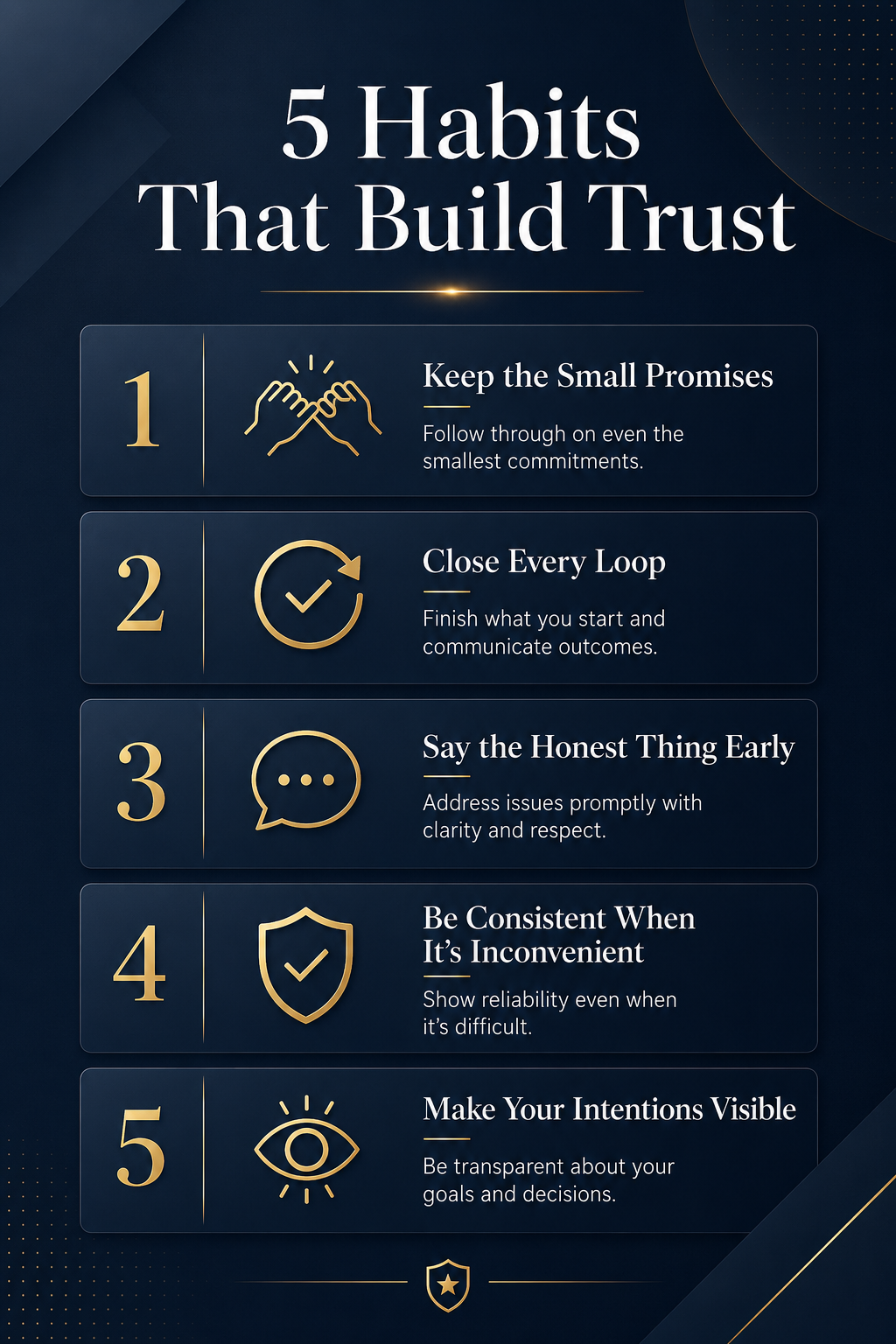
Pro Tip: Keep the Small Promises
The 15-minute call you said you'd make. The file you said you'd send by Friday. These unglamorous, easy-to-forget commitments are where trust is actually built, not in the big, visible moments everyone already expects you to show up for.
People notice the small promises far more closely than the big ones, precisely because no one is watching to make sure you keep them. That's exactly why they count more.
Pro Tip: Close Every Loop
Whenever you say you'll get back to someone, do it, even if the update is simply "still working on it." An unfinished loop left open doesn't disappear from someone's mind; it just quietly turns into doubt.
Silence is what erodes trust fastest, not delay. A short, honest "not there yet, here's where it stands" almost always lands better than saying nothing at all.
Pro Tip: Say the Honest Thing Early
Deliver difficult news as soon as you have it, not once it's easier to explain or once you've found a gentler way to frame it. The delay itself is usually what damages trust, not the news.
People forgive bad news far more readily than they forgive discovering it too late, or worse, discovering it from someone other than you.
Pro Tip: Be Consistent When It's Inconvenient
Anyone can be reliable when it costs them nothing. Real trust is built in the moments where honouring a commitment is genuinely inconvenient, and you do it anyway.
Those are the moments people remember longest, because they reveal something a good week never can: who you are when it would have been easy to be someone else.
Pro Tip: Make Your Intentions Visible
Trust grows faster when people don't have to guess why you did something. Where possible, share your reasoning, not just your decision.
Transparency closes the gap where suspicion tends to grow. Explained decisions build trust even when people disagree with them — unexplained ones erode it even when they're right.
Why This Skill Matters More Than Ever
Today's professional relationships are more distributed, more transactional, and more easily replaced than at any point in the past.
- →Teams change faster.
- →Relationships form over fewer touchpoints.
- →Reputation travels further, and faster, than it used to.
In this environment, the ability to build long-term trust has become one of the most underrated competitive advantages a leader can have.
Because skills and strategy get you into the room. It's trust that determines how long people stay in it with you, and how far they're willing to go on your behalf.
That is where influence, loyalty and lasting impact all quietly begin.
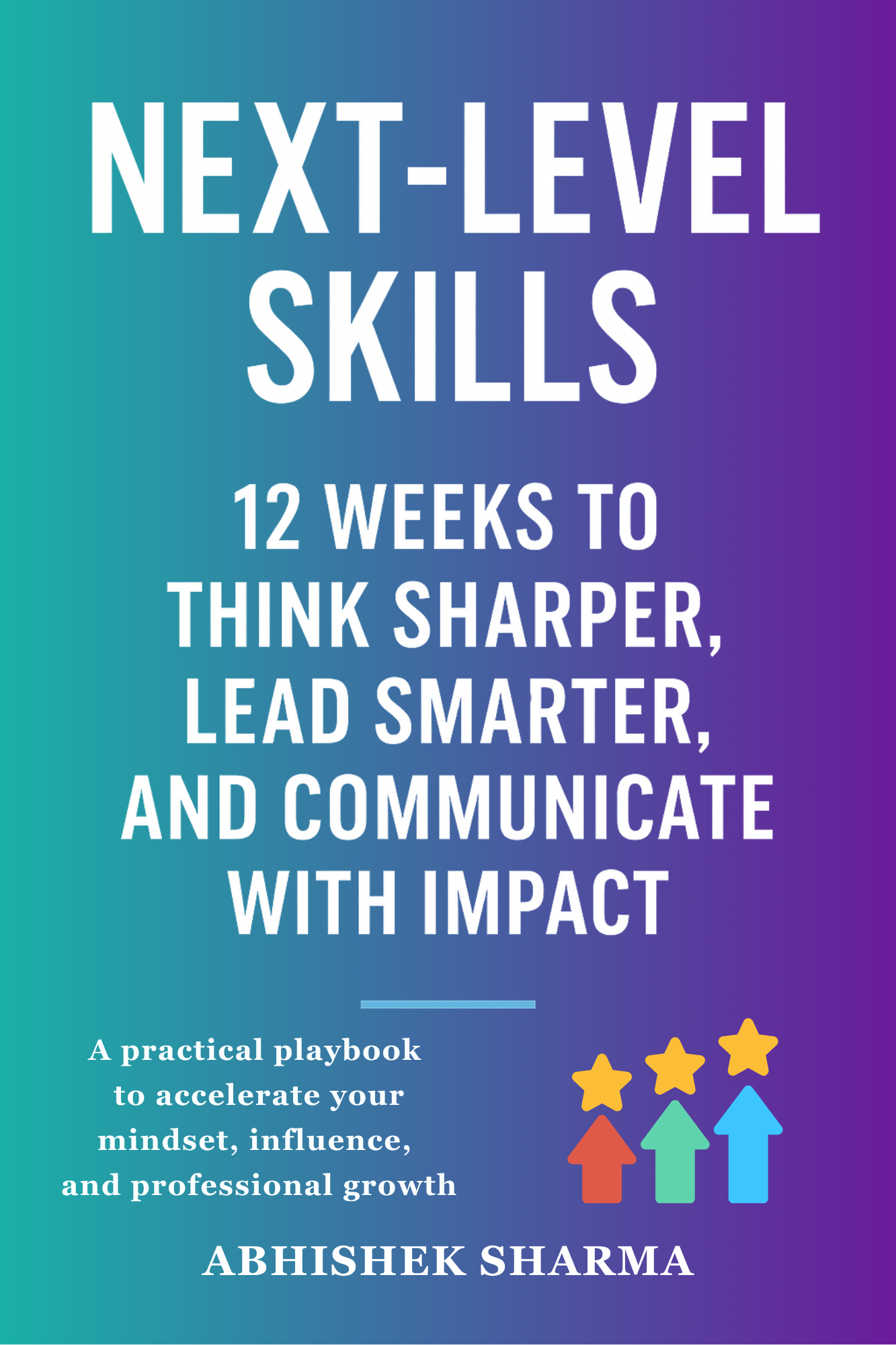
This and other essential skills are covered in Next-Level Skills — the book.
Learn more about the Book →A Reflection for This Month
Think about someone you trust completely, professionally or personally.
Reflection Questions
The answers to those questions often reveal more about our leadership than any single achievement does.
Some Final Thoughts...
Trust is rarely built in the spotlight. It is built in the follow-through.
The leaders who earn it long-term are not those with the most impressive first impression.
They are the ones who remain the same person, showing up with the same reliability, whether or not anyone is watching.
"It takes 20 years to build a reputation and five minutes to ruin it."
— Warren Buffett
That reputation, built slowly and protected deliberately, is what long-term trust really is. And ultimately, it is what makes everything else we do together possible.
Until Next Month, keep building trust that lasts.
Abhishek
Founder & CEO, LegiQ | Building Intelligent Edge Hardware
Buy the Book
- ✓Learn the full Next-Level Skills framework.
- ✓Build clarity, influence, and decision-making strength.
- ✓Accelerate your personal and professional growth.
This and other essential skills are covered in Next-Level Skills — the book.
Learn more about the Book →Enjoyed this edition?
Get the next one in your inbox — first week of every month.