Emotional Mastery at Work
Leading Yourself Before You Lead Anyone Else
Welcome back to another edition of Next-Level Skills. Each edition, we explore the human and leadership capabilities that help us navigate work and life more effectively. Skills that move beyond theory and into practical application.
A warm welcome to everyone who has joined our community since the last edition. Whether you've been with us since the beginning or have recently discovered the newsletter or the book, thank you for being part of this journey.
This month, we're exploring a skill that quietly determines how well we lead, decide and connect, especially under pressure:
Because emotional mastery isn't about suppressing what you feel. It's about not letting what you feel make your decisions for you.
The Meeting I Almost Wrecked
A few years ago, I sat in a meeting where a colleague publicly questioned a decision I'd made, in front of the exact people I most wanted to impress.
The comment wasn't entirely fair. It also wasn't entirely wrong. And in that half-second, I felt the familiar heat rise, the urge to defend, to correct, to win the room back.
Almost no one would have blamed me for pushing back hard.
I didn't. I paused instead.
Not because I was naturally calm in that moment. I wasn't. But because I'd practiced, many times before, creating just enough space between what I felt and what I said next.
That pause changed the entire tone of the meeting. It turned a potential standoff into a genuine conversation, and it earned me more credibility in that room than winning the argument ever would have.
And that is why emotional mastery deserves far more attention than it usually gets, especially from leaders who assume it's a personality trait rather than a skill.
Why Reactivity Costs More Than It Feels Like In the Moment
Emotional mastery is not about feeling less.
It is about widening the gap between the feeling and the response, so the response is a choice, not a reflex.
The challenge is that reactivity feels justified in real time.
The sharp reply feels earned.
The defensive tone feels reasonable.
And in the moment, almost no one registers the cost, because the cost rarely arrives immediately.
It arrives later, in the meeting people quietly stop inviting you to, in the feedback people stop giving you honestly, in the trust that erodes just slightly every time your reaction outpaces your judgment.
The instinct is to treat composure as something you either have or don't. In reality, it is a muscle, one that gets stronger with deliberate use and weaker with neglect.
The Myth of the Naturally Calm Leader
Many people assume emotionally masterful leaders simply feel less, that they're wired with some kind of natural detachment the rest of us weren't given.
What actually separates them is practice, not temperament.
They feel frustration, doubt and pressure just as intensely as everyone else.
But they have rehearsed the pause enough times that it has become their default, not their exception.
And it is that rehearsed pause, more than any innate calm, that lets them respond with judgment instead of urgency.
"Between stimulus and response, there is a space."
— Viktor Frankl
The goal should not be to eliminate the emotion. It should be to make sure the emotion never gets to decide for you.
What Emotionally Masterful Leaders Do Differently
Across high-pressure teams and difficult conversations, leaders with strong emotional mastery tend to do several things consistently.
- →They name what they're feeling before they act on it.
- →They separate the facts of a situation from the story they're telling themselves about it.
- →They regulate their body first, knowing a racing heart rarely makes room for good judgment.
- →And they repair quickly when their reaction misses the mark, instead of defending it.
In other words, they make themselves hard to provoke, and quick to recover.
That approach doesn't mean difficult moments stop being difficult. But it dramatically changes how those moments are remembered, by everyone in the room.
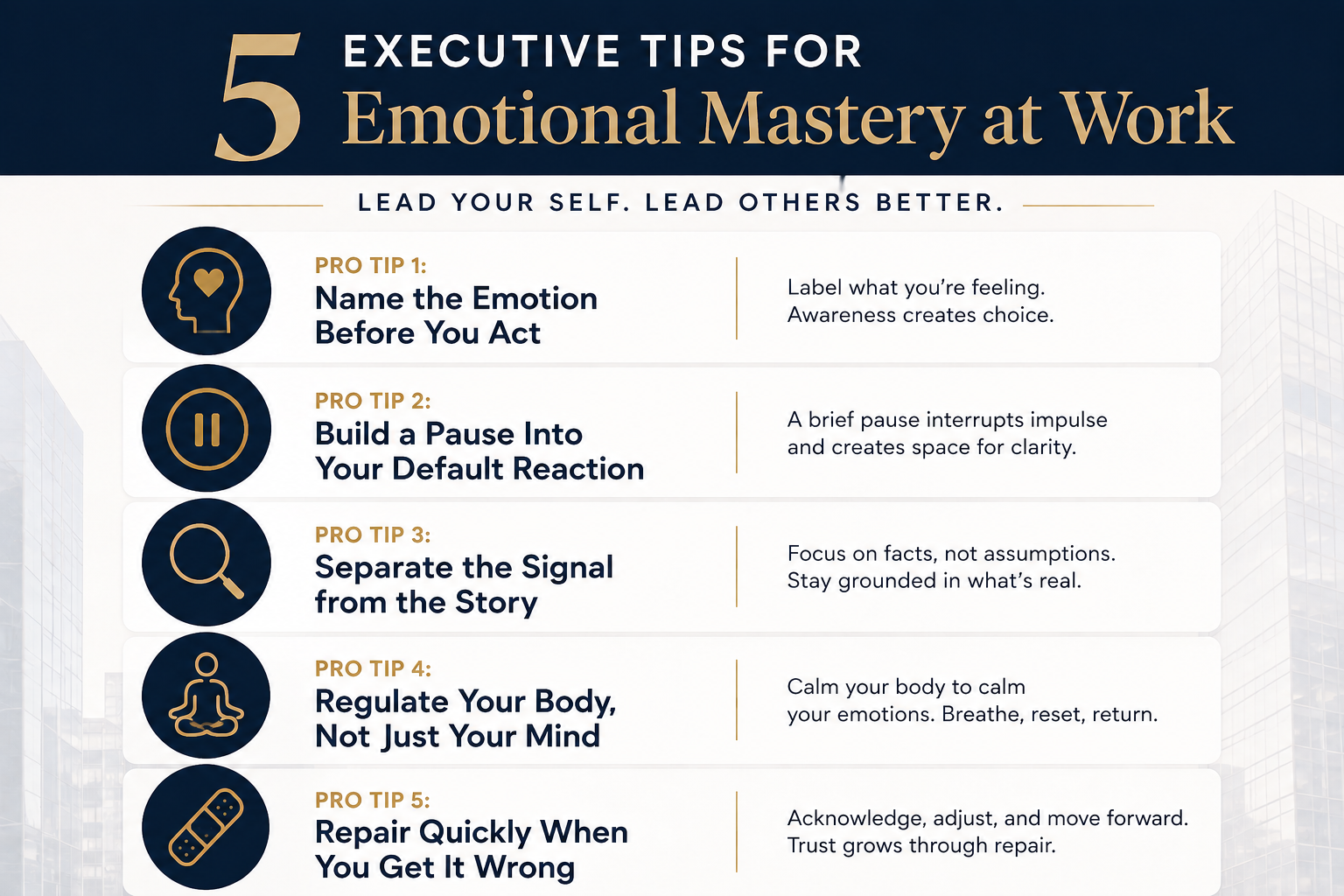
Pro Tip: Name the Emotion Before You Act
Silently naming what you're feeling, "I'm frustrated," "I feel defensive," "I feel dismissed", creates just enough distance between the feeling and your next move to actually choose one.
An emotion that's been named loses some of its grip. An emotion that stays unnamed tends to drive the car without you noticing.
Pro Tip: Build a Pause Into Your Default Reaction
You don't need ten minutes. You need one breath, one sentence of silence, one "let me think about that for a second" before you respond to something that's charged.
The pause is not hesitation, it's a decision to respond on purpose. Almost every regretted reaction happens in the absence of one.
Pro Tip: Separate the Signal from the Story
What was actually said or done is the signal. What you're assuming it means about you, your competence, or your standing is the story, and the story is almost always doing more damage than the signal itself.
Before reacting, ask: "What actually happened, versus what am I telling myself it means?" The gap between those two answers is often where the real problem lives.
Pro Tip: Regulate Your Body, Not Just Your Mind
A racing heart and a tight chest will shape your response whether or not you've talked yourself into staying calm. Physiology moves faster than willpower.
A slow exhale, unclenching your jaw, or simply lowering your shoulders before you speak does more for your composure than any mental pep talk in the moment. Calm the body, and the mind tends to follow.
Pro Tip: Repair Quickly When You Get It Wrong
Even with practice, you will occasionally react before you mean to. What separates emotionally masterful leaders isn't a flawless track record, it's how fast they repair it.
A quick, specific acknowledgment, "That came out sharper than I meant it to," rebuilds trust faster than pretending it didn't happen ever will.
Why This Skill Matters More Than Ever
Today's work environment gives emotional reactivity more room to do damage, and more places to be witnessed, than at almost any point before.
- →More conversations happen over text and chat, where tone is easy to misread and hard to walk back.
- →Teams are more distributed, so fewer relationships have the buffer of in-person trust to absorb a bad moment.
- →And a single reactive email or comment can travel far further, and last far longer, than it used to.
In this environment, the ability to stay composed under pressure has become one of the most valuable, and most visible, leadership skills a person can build.
Because talent gets you into difficult conversations. It's emotional mastery that determines whether you come out of them with your credibility intact, or your relationships quietly damaged.
That is where real influence, and real trust, are won or lost.
This and other essential skills are covered in Next-Level Skills — the book.
Learn more about the Book →A Reflection for This Month
Think about the last time you reacted in a way you later wished you hadn't.
Reflection Questions
The answers to those questions often reveal more about our leadership than any single achievement does.
Some Final Thoughts...
Emotional mastery is rarely built in calm conditions. It is built in the exact moments that test it.
The leaders who develop it aren't the ones who feel the least.
They are the ones who have practiced the pause enough times that it shows up automatically, exactly when it matters most.
"The most important quality for an investor is temperament, not intellect."
— Warren Buffett
The same is true for leaders. That temperament, built deliberately and practiced consistently, is what emotional mastery really is. And ultimately, it is what makes clear judgment possible when it matters most.
Until Next Month, keep leading yourself first.
Abhishek
Founder & CEO, LegiQ | Building Intelligent Edge Hardware
Apply These Skills
- ✓Put the frameworks into practice this month.
- ✓Use the reflection prompts inside the book.
- ✓Build habits that compound over time.
This and other essential skills are covered in Next-Level Skills — the book.
Learn more about the Book →Enjoyed this edition?
Get the next one in your inbox — first week of every month.