Resilience
Resilience: The Strength to Rise Above Challenges
Welcome back to another edition of Next-Level Skills. Each edition, we explore the human and leadership capabilities that help us navigate work and life more effectively. Skills that move beyond theory and into practical application.
A warm welcome to everyone who has joined our community since the last edition. Whether you've been with us since the beginning or have recently discovered the newsletter or the book, thank you for being part of this journey.
This week, we focus on Resilience, a skill that equips us to face adversity, adapt to change, and keep moving forward. In a world filled with uncertainties, resilience acts as our anchor and compass.
A Storm, a Team, and a Lesson in Resilience
Several years ago, I was leading a major product launch when a last-minute technical glitch delayed the release. The team was exhausted after months of preparation, and morale plummeted. Some questioned if we could deliver at all, chaos creeped in quick.
Instead of allowing the setback to derail us, we regrouped. I encouraged the team to focus on what was within our control and break the problem into smaller, actionable steps. We all worked through the night, testing and refining until the issue was resolved. The launch was a success — not because it was flawless, but because the team’s resilience turned a potential failure into a learning experience and prepared us through. Overcoming this last-minute chaotic setback successfully, we felt more confident to face similar challenges in future!
What is Resilience?
Resilience is our ability to recover from setbacks, adapt to new circumstances, and continue pursuing our goals despite obstacles. It’s not a fixed trait but a skill that can be cultivated through an ongoing combination of conscious practice and an honest self-reflection.
I can be changed by what happens to me. But I refuse to be reduced by it.
— Maya Angelou
Why Resilience Matters
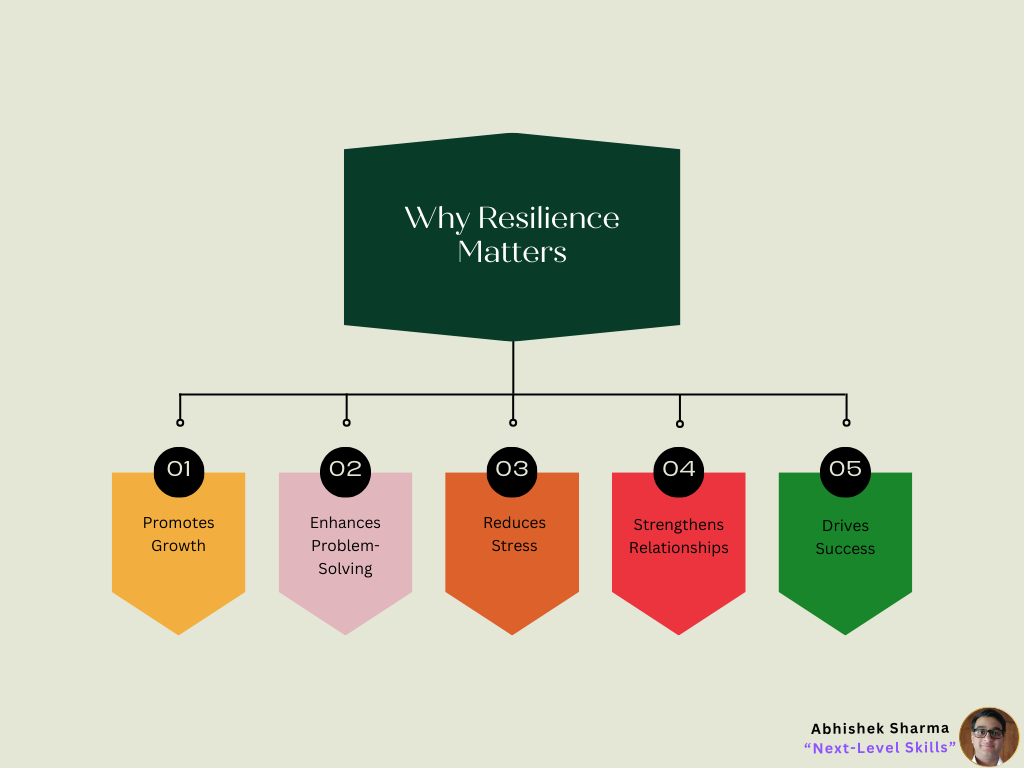
Resilience is more than just bouncing back — it’s a key driver of long-term success and emotional well-being. Resilience —
- 1Promotes GrowthResilient individuals turn challenges into opportunities to learn and grow.
- 2Enhances Problem-SolvingResilience helps us approach setbacks with clarity, enabling creative solutions.
- 3Reduces StressA resilient mindset shifts our focus from problems to possibilities, reducing overwhelm.
- 4Strengthens RelationshipsResilience fosters empathy and trust, making us more supportive colleagues and leaders.
- 5Drives SuccessResilient professionals navigate change effectively, positioning themselves for sustained progress.
To build resilience, we need to understand its key components and incorporate them into our daily lives. Each of these components plays a vital role in helping us navigate challenges with confidence, clarity, and strength.
Let’s explore the fundamental pillars that support resilience.
The Pillars of Resilience
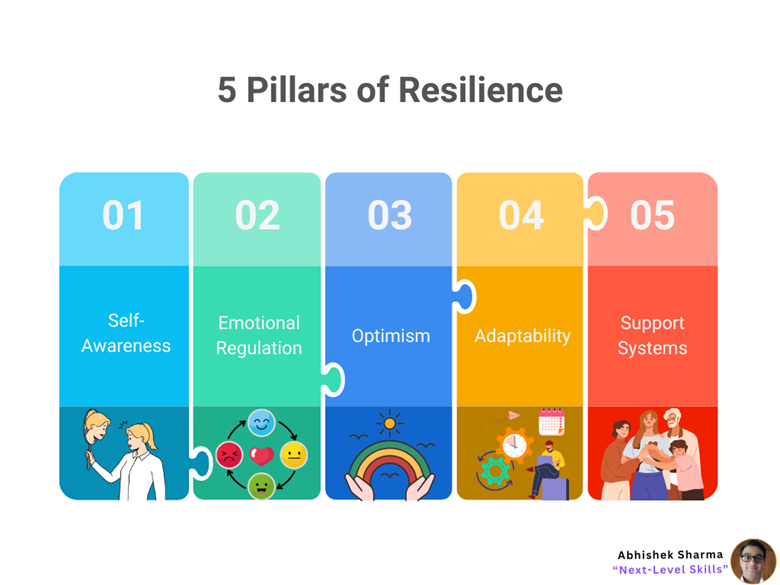
Resilience is not a singular trait but a combination of attitudes, behaviours, and practices that empower us to handle adversity effectively. It’s built on a foundation of essential elements that, when developed, enable us to stay grounded and focused, serving ultimately as our anchor and compass in those turbulent times.
Let’s delve into the 5 key pillars that form the core of resilience.
- 1Self-AwarenessRecognising our emotions and understanding their impact on our behaviour. “He who has a why to live can bear almost any how.” – Friedrich Nietzsche
- 2Emotional RegulationStaying calm and composed under pressure by managing our reactions.
- 3OptimismFocusing on possibilities rather than problems, even in challenging situations.
- 4AdaptabilityEmbracing change and finding creative ways to navigate it.
- 5Support SystemsBuilding strong connections with colleagues, mentors, and friends for encouragement and guidance.
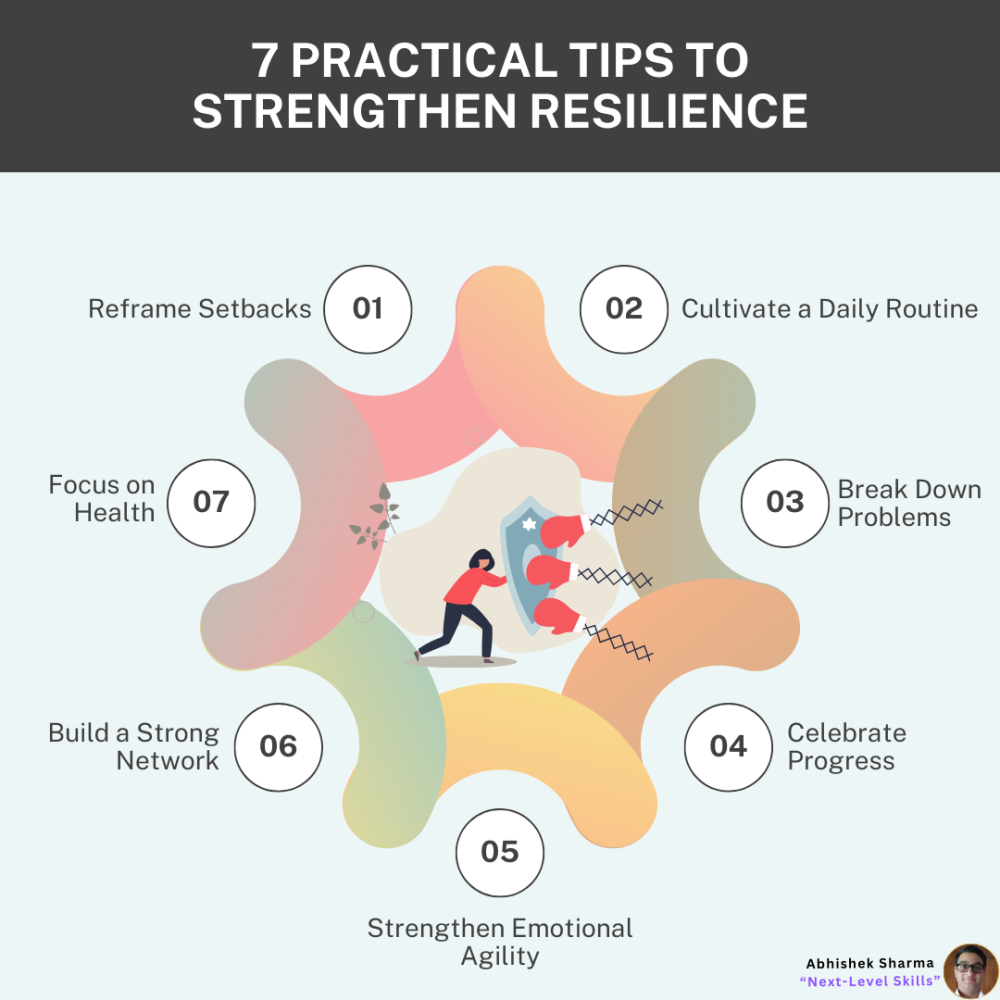
Each of these below practical tips strengthens our ability to navigate challenges with confidence and clarity. By incorporating these strategies into our daily lives, we build the mental and emotional stamina to thrive in the face of adversity.
1. Reframe Setbacks
Pro Tip: Shift our mindset by viewing challenges as opportunities for growth and self-improvement. Reframing helps us approach setbacks with curiosity rather than frustration, fostering a solution-oriented mindset.
Example: Instead of saying, “This setback ruined our plans,” reframe it as, “This is a chance to innovate and find new solutions that could benefit us in the long term.” Consider journaling about how a recent challenge taught us a valuable lesson or opened unexpected doors.
2. Cultivate a Daily Routine
Pro Tip: Establishing consistent daily habits creates stability and reduces decision fatigue, providing a solid foundation even in uncertain times. A well-structured routine allows us to focus on what we can control and creates a sense of normalcy.
Example: Begin each day with a 10-minute reflection or journaling session to set a positive tone. Pair this with a mid-day check-in to adjust priorities or decompress with a calming ritual like tea or mindfulness exercises.
3. Break Down Problems
Pro Tip: Break down overwhelming tasks into smaller, achievable milestones to maintain focus and motivation. Realistic goals provide clarity and prevent us from feeling paralysed by the enormity of the task ahead.
Example: If tackling a large project, focus on completing one section at a time rather than aiming to finish everything at once. Create a timeline that includes mini-deadlines and celebrate meeting each milestone, no matter how small.
4. Celebrate Progress
Pro Tip: Acknowledge progress, no matter how minor, to maintain motivation and build confidence. Celebrating small victories creates momentum and reminds us of our ability to overcome obstacles.
Example: Completing a challenging task or overcoming a minor hurdle is worth celebrating — it reinforces confidence. For instance, finishing the first draft of a report or learning a new skill could be followed by a small reward like a break or treating ourselves to something enjoyable.
5. Strengthen Emotional Agility
Pro Tip: Practice pausing and assessing before reacting to stressors. Emotional agility helps us respond thoughtfully rather than impulsively, which is crucial during high-pressure situations.
Example: When faced with criticism, take a deep breath and ask, “What can I learn from this?” rather than reacting defensively. Over time, this habit strengthens our ability to stay composed, even when emotions run high. Additionally, practice labelling emotions to understand them better, such as identifying feelings of frustration as a signal to reset expectations.
6. Build a Strong Network
Pro Tip: Reach out to mentors, colleagues, or friends for guidance and encouragement. Strong support networks provide perspective, accountability, and emotional relief during challenging times.
Example: Sharing challenges in a trusted network often brings fresh perspectives and emotional relief. For instance, discussing a workplace setback with a mentor might lead to actionable advice or reassurance that the situation is manageable.
7. Focus on Health
Pro Tip: Physical well-being enhances mental resilience by improving energy, focus, and emotional regulation. A healthy body and mind form the foundation for bouncing back from adversity.
Example: Prioritise regular exercise, balanced nutrition, and quality sleep, especially during stressful periods. For instance, a brisk 20-minute walk after work can help clear our mind and re-energise us for the next day. Staying hydrated and avoiding burnout through planned breaks also contribute to long-term resilience.
Resilience is a skill we cultivate over time by embracing consistent habits, practising self-awareness, and seeking support when needed.
This and other essential skills are covered in Next-Level Skills — the book.
Learn more about the Book →A Challenge
Think of a recent challenge or setback. Ask yourself:
Reflection Questions
Choose one pillar of resilience — whether it’s self-awareness, optimism, or building support systems — and take a small step to strengthen it this week.
Some Final Thoughts...
Resilience is not about avoiding hardship but about growing through it. It’s a skill that we can cultivate over time, empowering us to embrace change, find strength in adversity, and continue pursuing our goals with confidence.
The greatest glory in living lies not in never falling, but in rising every time we fall.”
— Nelson Mandela
Thank you for joining us in this exploration of resilience. Let’s continue to support and inspire each other on this journey.
Until Next Time,
Abhishek
Founder & CEO, LegiQ | Building Intelligent Edge Hardware
What’s a challenge that taught you the most about resilience, and why?
How do you maintain a positive mindset during prolonged setbacks?
What daily habits help you build mental and emotional strength?
How do you support team members in developing resilience during tough projects?
What role does reflection play in strengthening your resilience?
Can you recall a situation where someone else’s resilience inspired you?
How do you balance being adaptable with staying committed to your goals?
What strategies do you use to bounce back from disappointment?
How can workplaces cultivate resilience among employees?
What’s one piece of advice you’d give to someone struggling to stay resilient?
Apply These Skills
- ✓Put the frameworks into practice this month.
- ✓Use the reflection prompts inside the book.
- ✓Build habits that compound over time.
This and other essential skills are covered in Next-Level Skills — the book.
Learn more about the Book →This edition is reserved for supporters
Subscribe free, then unlock every past edition with just 1 successful referral.
Subscribe Free →Enjoyed this edition?
Get the next one in your inbox — first week of every month.