Managing Up
Managing Up - Leading Without the Title
Welcome back to another edition of Next-Level Skills. Each edition, we explore the human and leadership capabilities that help us navigate work and life more effectively. Skills that move beyond theory and into practical application.
A warm welcome to everyone who has joined our community since the last edition. Whether you've been with us since the beginning or have recently discovered the newsletter or the book, thank you for being part of this journey.
This week, we’re unpacking a game-changing skill for every level of the organisation: Managing Up. Whether we’re reporting to one person or presenting to an executive board, our ability to align with and support those above us is critical, not just for our own success, but for the success of the team and organisation as a whole.
The Day I Stopped Waiting for Direction
Years ago, I was working on a cross-functional project with a senior leader known for being “hands-off.” Initially, I found it frustrating : no feedback, vague expectations, and minimal check-ins. I kept waiting for clarity.
Eventually, a mentor gave me some advice:
So I did. I began sending concise weekly updates, highlighted key decisions in advance, flagged potential risks early. And to my surprise, that leader became one of my biggest advocates.
That project taught me this:
Why Managing Up Matters
We often think leadership flows top-down, but some of the most powerful influence happens bottom-up. Managing up is the practice of working with our leaders, not just for them.
Done well, it builds trust, enhances visibility, and improves decision-making across the organisation.
The most important thing in communication is hearing what isn’t said.
— Peter Drucker
Managing up is our way of listening, aligning, and proactively filling those gaps.
Now, let’s look at what managing up actually looks like in practice.
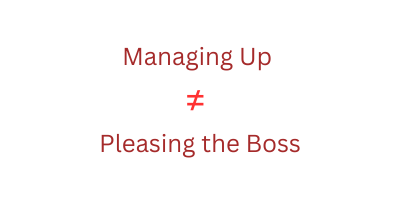
It’s important to clear up a myth — managing up isn’t about saying “yes” to everything or acting as a people-pleaser.
It’s about building a collaborative, mutually beneficial relationship where we anticipate needs, share perspective, and create clarity.
- →It’s not obedience. It’s ownership.
- →It’s not flattery. It’s foresight.
- →It’s not doing more. It’s doing what matters.
Let’s now explore the practical ways we can manage up effectively, regardless of our level or role.
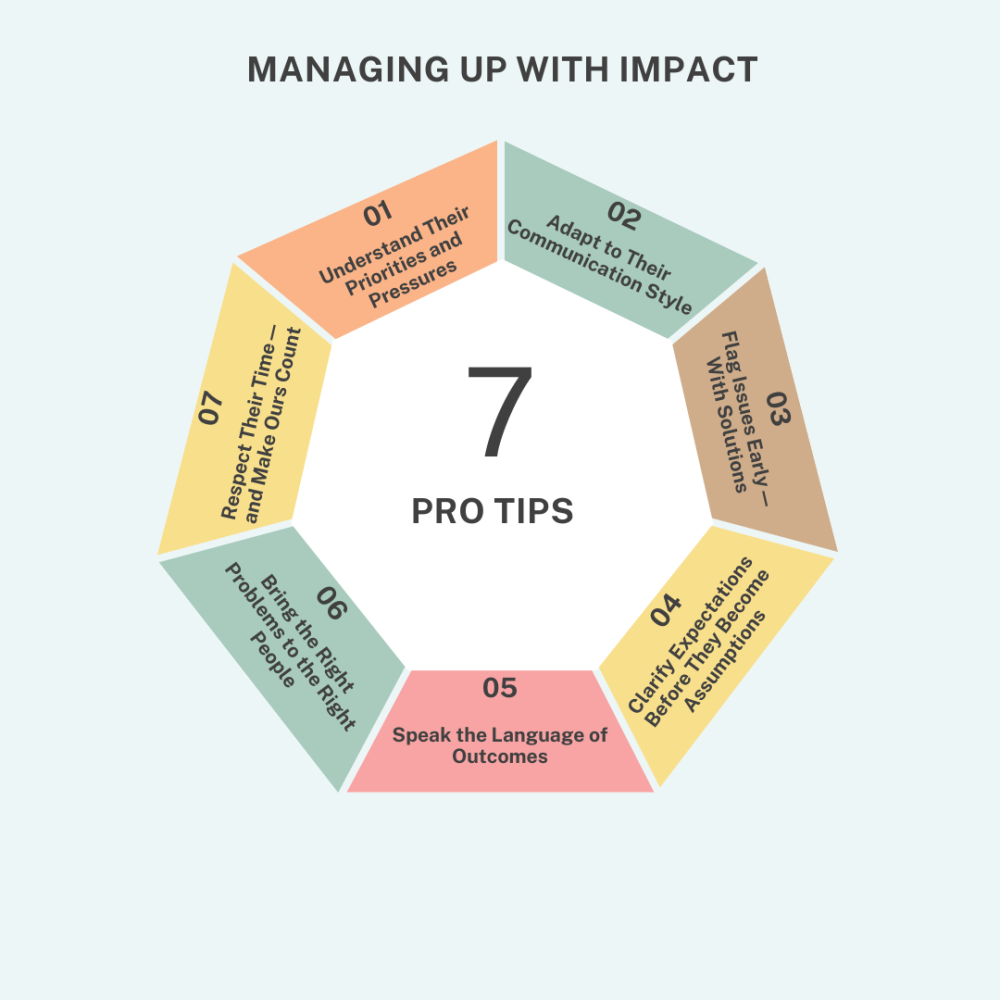
1. Understand Their Priorities and Pressures
Study what matters to our manager, what they’re being measured on, where their stress lies, and what success looks like from their perspective.
Pro Tip: If the manager is under pressure to reduce turnaround times, streamline how we share updates and decisions.
2. Adapt to Their Communication Style
If the manager prefers brief emails, don’t write essays. If they prefer visuals over numbers, adapt accordingly. Influence flows where alignment grows.
Pro Tip: Use bullet points for decision summaries or send a visual snapshot instead of a 10-slide deck.
3. Flag Issues Early — With Solutions
Don’t hide problems until they explode. Bring them up early with 1–2 possible paths forward. Leaders don’t want perfect — they want proactive.
Pro Tip: Communicate like this “We’re at risk of missing X due to Y. Here are two ways to pivot — Option A and Option B.”
4. Clarify Expectations Before They Become Assumptions
When starting a project or task, clarify: What does success look like? What are the non-negotiables?
Pro Tip: Convey “To ensure we’re aligned, here’s how I’m thinking of approaching this — anything you’d add or change?”
5. Speak the Language of Outcomes
Executives deal in results. Translate activity into impact.
Pro Tip: Instead of “We held three workshops,” say, “The workshops led to a 25% reduction in onboarding time.”
6. Bring the Right Problems to the Right People
Be mindful of what issues we escalate and how. If it can be solved at our level, solve it. If not, bring it with context and clarity.
Pro Tip: Avoid “We’ve got a problem.” Instead: “Here’s the challenge, what’s at stake, and how it links to our team’s goals.”
7. Respect Their Time — and Make Ours Count
Be concise. Be prepared. Every interaction is an opportunity to demonstrate our value and awareness.
Pro Tip: Send an agenda ahead of a one-on-one. End meetings with clear next steps and ownership.
This and other essential skills are covered in Next-Level Skills — the book.
Learn more about the Book →A Challenge
Try this three-part challenge to practise managing up:
Reflection Questions
Some Final Thoughts...
Managing up is about proactivity, empathy, and strategic alignment. It helps us elevate not only our own performance but the performance of those around us. When we learn how to manage across - not just down or up - we become indispensable.
Whatever we vividly imagine, ardently desire, sincerely believe, and enthusiastically act upon must inevitably come to pass.
— John Wooden
Let’s start acting like the leaders we’re growing into.
Until Next Time,
Abhishek
Founder & CEO, LegiQ | Building Intelligent Edge Hardware
What’s one assumption you’ve made about your manager’s priorities that you could test?
When was the last time you made your manager’s life easier?
What’s your current relationship like with your boss — and what’s one thing you can do to improve it?
Do you truly know what success looks like from your leader’s point of view?
When have you successfully influenced a decision above your level?
How do you currently bring issues to your boss — early or only when they escalate?
How do you know if you’re managing up or just managing to please?
Are you tailoring your updates to suit their decision-making style?
Who’s someone you admire for managing up well, and what can you learn from them?
What’s one thing your leader repeatedly asks you for that you could anticipate instead?
Gift the Book
- ✓A colleague stepping into leadership.
- ✓A team member navigating change.
- ✓A friend looking to take their next step professionally.
This and other essential skills are covered in Next-Level Skills — the book.
Learn more about the Book →This edition is reserved for supporters
Subscribe free, then unlock every past edition with just 1 successful referral.
Subscribe Free →Enjoyed this edition?
Get the next one in your inbox — first week of every month.